A sense of belonging

Architecture NZ columnist Karamia Müller.
Reader, as you will know, architect Pip Cheshire passed away on 11 February. Amanda Harkness, deputy editor for Architecture NZ, would email us together about deadlines and, often, Pip and I would reply with a shared sense of dread about submitting our columns, fingers crossed on time, though likely a little later than requested. Pip was one of those people with whom you always felt you might be up to something. He made camaraderie feel easy, almost conspiratorial. When I heard the news of his death, I thought immediately of a lunch we had as this magazine’s editorial team only last December, and of the way he made me feel as though I had been let in on something not everyone knew.
At his funeral, I found myself standing at the doorway of St Matthew-in-the-City. Inside, people stood tightly knitted in a sad mist of black. I turned because I sensed someone behind me, and a handsome man came through the door, pausing briefly to assess the crowd. A few minutes later, I realised he was one of Pip’s sons, standing alongside Nat. I found myself thinking, too, of what it is to share your father with a profession. I remember wondering what it must be to farewell a father alongside hundreds of others. Looking around the room, it was moving to see that Pip’s way of making one feel like a comrade was not limited to me. What struck me was that here, unmistakably, was a community.
Pip had built a community around him: through advocating for the profession, believing in it, participating in it and, perhaps most importantly, loving it. It occurred to me that the real church we were standing in was not only the church of family and faith but, also, the archways of an architectural public. A friend of mine often quotes Groucho Marx: “The trouble with clubs is that there is no club you want to be in that is worth being in.” And yet architecture, at its best, has sometimes felt to me like precisely that impossible thing: a flawed, disputatious, occasionally ridiculous club that is, nevertheless, worth belonging to. Though I often feel, Groucho-like, at the edges of this amorphous group, I remember thinking, as I saw familiar faces, how lucky I was to belong to this clan.
Lately, when I am driving and thinking about this column, I often think about you. I wonder whether or not you are tired of hearing from me. I imagine you looking at the title and my picture and thinking, perhaps with some justification, that I ought to familiarise myself more thoroughly with the building code, and that the left-leaning academic schtick may well have run its course. I imagine you wondering whether or not my columns are, in the end, too exhortatory. And perhaps, reader, you would not be entirely wrong.
Today, while writing this, I keep flipping back to a news image of the Strait of Hormuz: zooming in and out of that blue bottleneck of sea, rendered innocuous in photographic form and yet charged with immense geopolitical consequence. As I look at that narrow stretch of water, I find myself wondering: what is the point of an architecture column?
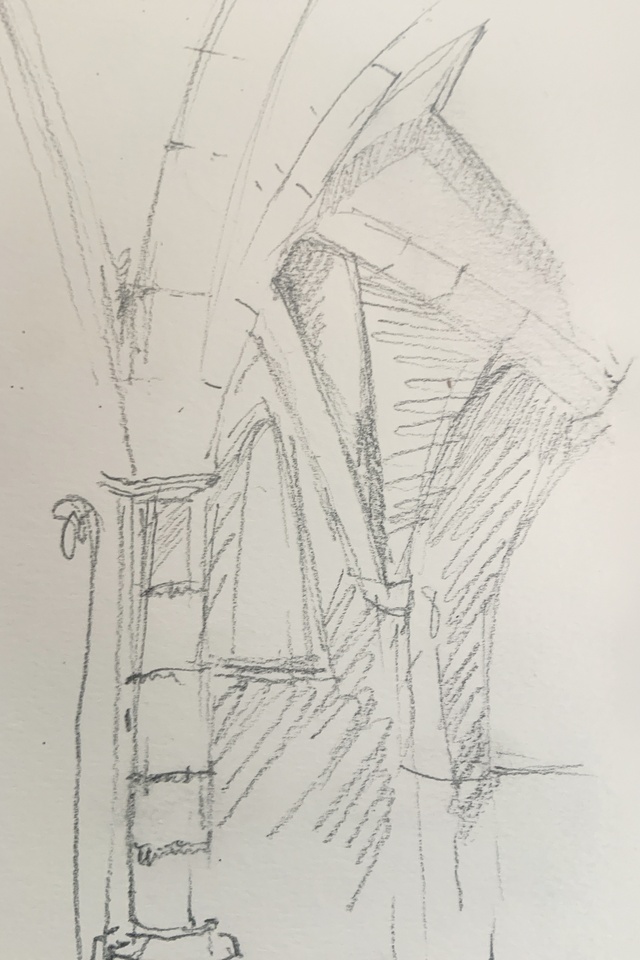
I think the answer is that buildings do not sit outside the world’s violence. They never have. The built environment is where politics becomes ordinary and material: in the price of fuel, in the distance between family members, in the routes still possible to travel, and in the homes people can no longer afford to heat, inherit, insure or keep. Architecture is not innocent of the world; it is one of the forms through which the world arrives. Perhaps that is the reason that so many of us fall in love with it, and why it can ask so much of us in return.
That has always been the wager of this column, even when I have not named it as such. An architecture column is not only for explaining buildings, policy settings, urban infrastructure or planning changes, though of course all of those things matter. It is also for asking what kind of world our buildings, rules and public conversations are making possible. What do they permit? What do they foreclose? Whom do they shelter? Whom do they leave negotiating the threshold?
Perhaps that is also why Pip’s farewell has stayed with me in the way it has. What I witnessed at his funeral was not simply esteem for a successful architect, nor only the mana he carried, but evidence of a life that had made room for others. In the end, that may be one of the highest callings of architecture and of architectural culture alike: not simply to produce buildings but to build the conditions under which people feel they belong to something larger than themselves.
I am not entirely sure what kind of column the present moment demands. The world feels at once unbearably large and claustrophobically tight. War, grief, professional life, energy anxiety and the practical business of carrying on all seem to occupy the same sentence. But perhaps that, too, is part of the point. We do not encounter architecture outside life. We encounter it in the middle of things: while mourning, while worrying, while commuting, and while trying to decide what matters and what kind of future can still be made.
If I have returned, again and again, to questions of care, inequity, history and belonging, it is because buildings are never only buildings. They are arrangements for living with one another. They are evidence of what we think others deserve. And perhaps that is all I have been trying to trace here, again and again, in one form or another.