Tower of now

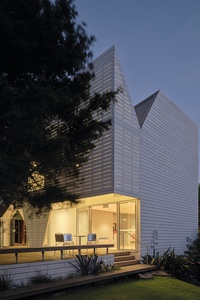
To generate ‘family resemblance’, the distinctive timber gothic form of the church was imagined as a cake, from which a carefully selected piece was sliced out.
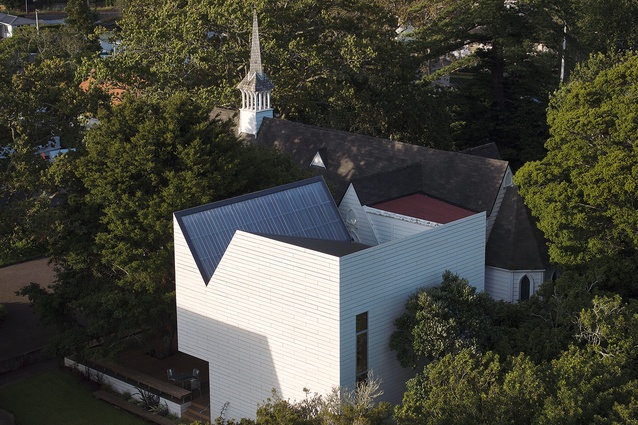
Replacing messy 1960s’ additions, the project is tucked tightly between a heritage church, established trees and historic stone walls.
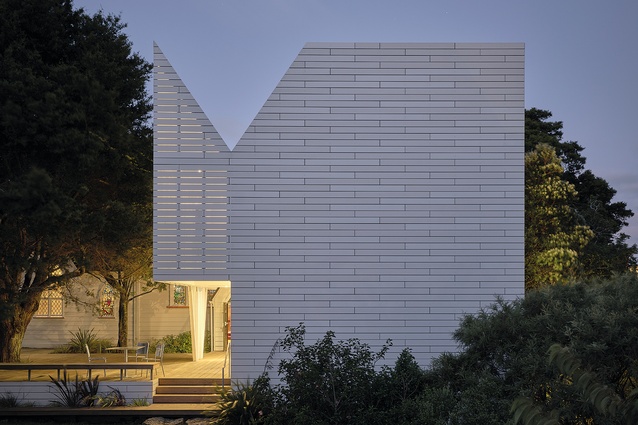
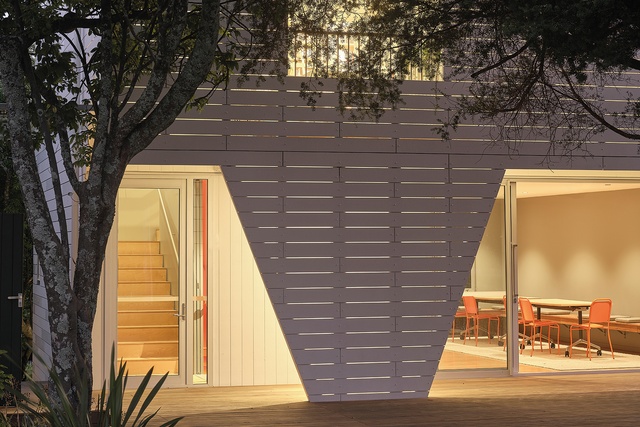
The main gathering space was configured as an outdoor rather than an indoor area, reducing the construction required.
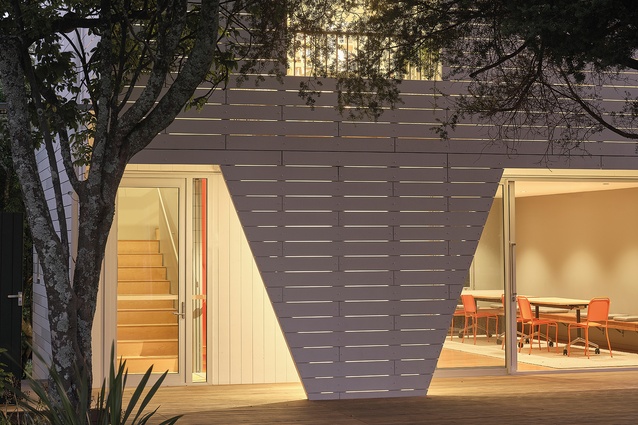
The design and construction process avoided the removal or trimming of any trees, despite existing trees touching the resulting new building on three sides.
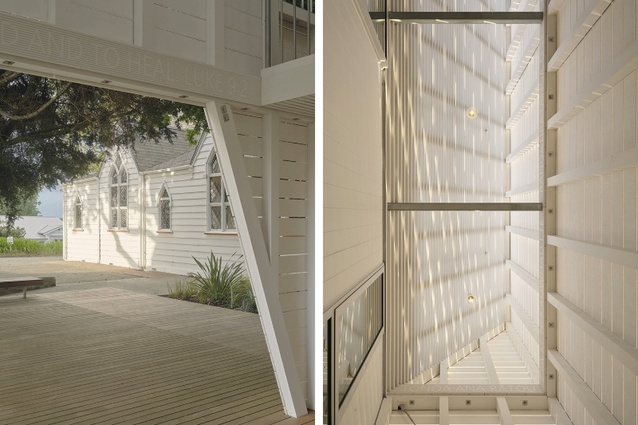
Configured for effortless accessibility, the new building’s floor was set level with the existing building, resulting in completely level access between the car park, hospitality spaces and church. The verandah is inscribed in Māori and English, with sacred texts from Saint Luke, the church’s patron saint.
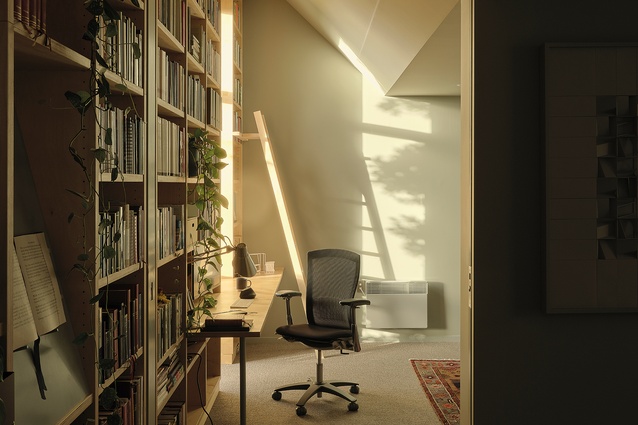
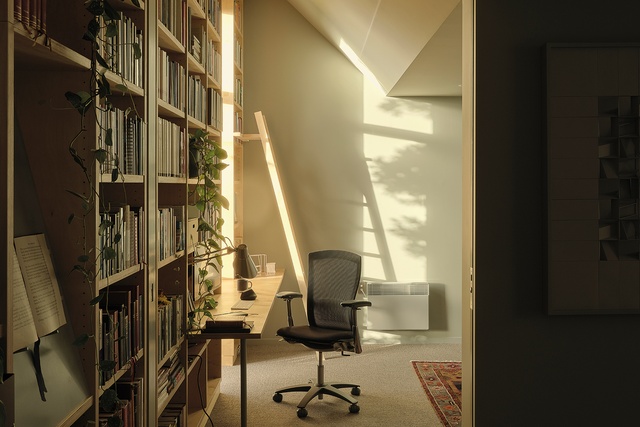
The vicar’s office is occupied by Rev. Clare Barrie, the designer’s wife, and her library.
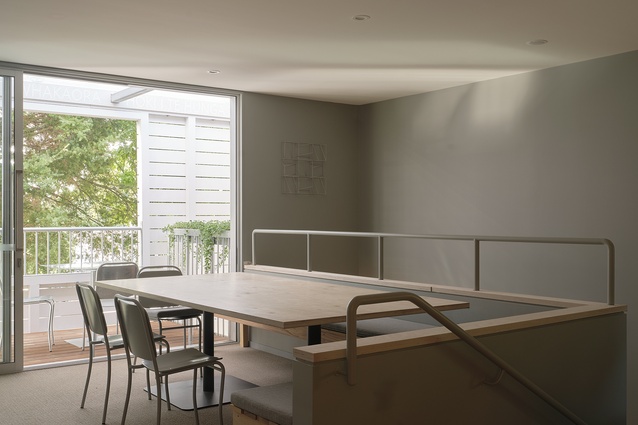
Old chairs from the demolished building were refurbished for re-use, avoiding both waste and the expense of buying new.
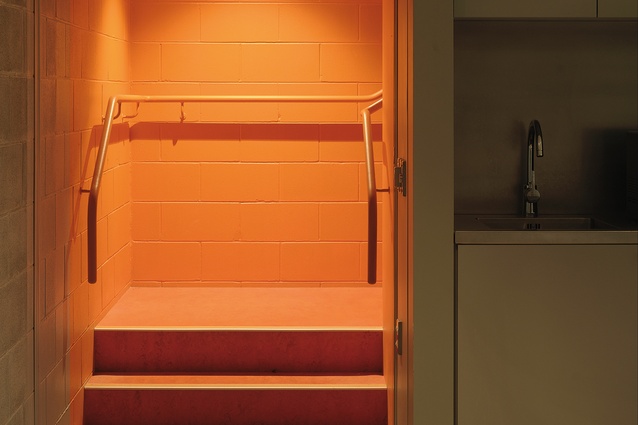
To help the site’s many visitors navigate, access to the toilets was coloured bright orange.
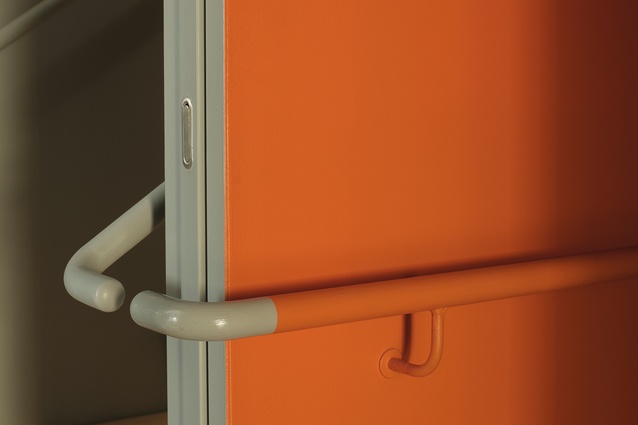
The building’s low cost meant surfaces and details remain simple.
Jeremy Smith discusses Andrew Barrie Lab’s new addition to Saint Luke’s Anglican Church in Auckland, cups of tea, architectural lineages and the ways in which communities enable building.
Cups of tea for a long way in architecture. Consider those buildings loquaciously brought into existence with milk and sugar. Yes, OK, hold back on the sweetener but, remember, little has changed in the chatting involved when communities enable building. Think of those folk supporting marae, community halls, sports clubs and church groups. The kōrero isn’t just a briefing preamble to the job book; it’s part of a story. It’s why a teapot comes with a cosy and why a cup has a saucer. Histories need to be kept warm and are forever overflowing.
Such lineages seem to congregate around Professor Andrew Barrie and Andrew Barrie Lab’s new tower addition at Saint Luke’s Anglican Church in Auckland. We are already talking historical contexts as we arrive via the cemetery that sits behind the church. Barrie carries a small chair, freshly painted bright orange, and is explaining how Kiwi architects “tend to get overly obsessed with the physical context of their work”. True, geographies extend well beyond what we can see and readily run in the written or the oral, from the celestial to the spiritual, and, even, perhaps, with a good stir, into the tea leaves themselves. Such “immaterial” readings, as landscape theorist Richard Hartshorne defines,1 are not so much topographic or even pointillistic in connecting the dots, as they are diarised. We need, Barrie explains, “less here and more now”. He’s talking to the white, cutely shaped addition standing by the church but also to the branches of our country’s architectural family tree. “We need to worry less about our place geographically and more about our place in time.” Cups of tea at the ready. Anybody who has seen Barrie’s alarmingly small three-point font might imagine the detail and effort in the response.
There won’t be many architects in Aotearoa who haven’t found some connection through Barrie. Those maps that regularly slip out of Architecture NZ might be coaster sized but they unfold an architectural genealogy. Barrie authors these maps to locate, but also credit, an architectural lineage that brings us to the now. Barrie’s own architectural narrative runs through Auckland student days to a doctorate at the University of Tokyo and work with Pritzker-winning architect Toyo Ito, to Cheshire Architects and, ultimately, to a professorship at the University of Auckland and establishing Andrew Barrie Lab.
There’s a clue in the ‘lab’ naming that borrows from the traditions of Japanese architects that both practice and teach. Even if you drive around only a little online, there’s a telling Andrew Barrie map to travel. Venice Biennale exhibitions in 1991 (awarded the Venice Prize at the “urging” of Arata Isozaki)2, 2012 (at which his and Simon Twose’s Familial Clouds exhibit positioned our architectural development as “unavoidably embedded within a specific place and time”, 3 and 2021 (where the Learning from Trees exhibit by the University of Auckland showcased Barrie’s “advancement of timber technology both in his teaching and his professional practice”.)4 But there’s also big-time buildings in Christchurch’s Cathedral Grammar, with Tezuka Architects, and ongoing work at Oxford Terrace Baptist Church that chase these lineages and technologies to the now and into this new work.
Understanding a place in time allows a little more stargazing as we leave the chair outside and move our conversation inside Saint Luke’s, which, Barrie tells me, was originally completed in 1872 by P. F. Martineau Burrows (1842–1920), who went on to become Chief Draftsman in the Colonial Architect’s Office. Later additions were made by prolific Auckland architect Edward Bartley (1839–1919) and by leading Arts and Crafts figure Basil Hooper (1876–1960). “A side effect of my writing,” Barrie confides, “is a consciousness of my place in architectural history, both socially and technologically. Hence the attempt to extend the innovations of timber gothic and of the various later folk — the Group, John Scott, Miles Warren, etc. — who themselves drew on those traditions and techniques.” The connection runs visibly back through the timber vaulting and tie rods of this little church to the Saint John the Evangelist Church (1847) in Meadowbank, with its externally expressed timber structure. You might imagine the teacups perhaps clinking a little as the outward expressed structure and eaves were pared back at Saint Luke’s and, again, in the subsequent lengthening and widening additions. But, as Barrie points out, it’s the kind of well-handled work that would have seen each of Burrows, Bartley and Hooper make their respective year’s architectural almanac, or, I counter, be jested into a Malcolm Walker-esque back-page cartoon for such eave-less contemporising.
Barrie himself made Walker’s infamous 2014 Le Ronchamp touring New Zealand architect rugby team cartoon5 as “Technical ‘Ah So’ Advisor”. But, at Saint Luke’s, Barrie seems not only to be in the playing team along with Andrew Barrie Lab’s Jade Shum, but to be captain and coach, planning the tour, writing the programme, washing the uniforms and, no doubt, pouring the tea. That’s where the painted chair fits. Barrie has somehow refinished it, and many others, in his free time. We deliver the chair to the new building, which sits politely behind the church and nearby an existing hall and a Girl Guide building. A cup-of-tealong preamble in reaching the now, perhaps, but it is through a commitment to understand the lineages and complexities of community work that Barrie undertakes the new building, which stands as a small tower to support the church.
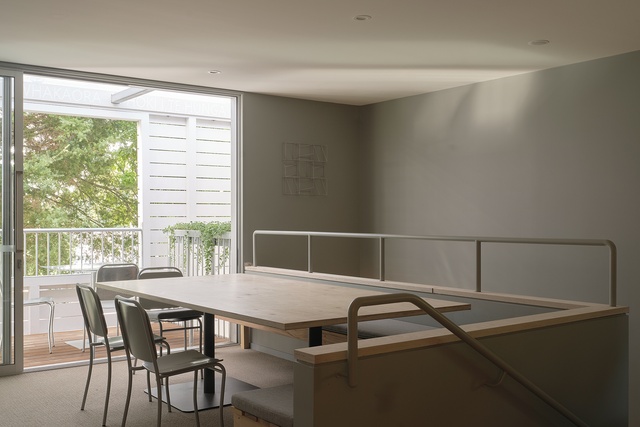
To limit excavation and avoid century-old landscape walls and existing trees, this new tower follows the footprint of a worn-out garage where the choir robes were previously stored. Down low, the new building houses leasable office space. Up top, Barrie expertly stretches a single space and stair through three storeys, hiding fire doors along the way, layering much-needed church offices and facilities off landings and even spiring up a bookcase ladder at the apex. All while providing a much-needed level entry and accessible facilities for the church and an external seating area beneath a mature tōtara tree. At this point in the discussions, I imagine the church planning committee incredulously reaching for the biscuits and leaning in to see what it might all look like. Here, Barrie speaks of “family resemblance”, stating the new building was conceived as the “great, great-grandchild of the old church, carrying the lineage forward but completely of its own time”.
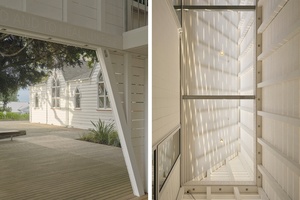
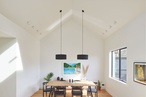
For, as you might now expect, the new draws scale, shape and structural typology from St Luke’s.The space, and roofing, runs high to low and back to high again. It’s a sectional lineage drawing on the church’s V-shaped dormers. This allows the tower to direct privacy through the entry verandah’s vaulted space and exposed structure as a contemporary take on the church’s timber gothic lineage. But the details run to Barrie’s own architectural lineage — particularly Fumihiko Maki, the professor of Barrie’s professor at the University of Tokyo. The tower’s open space planning is a little Maki’s Hillside Terrace-esque in not prescribing function.6 The painted handrails which colour-match the walls are distinctly Japanese in their simplicity. Those fibre-cement weatherboards are exactingly laid out to corner and crest without cover flashings and be truly eaveless. Even the deck spacings under the tōtara are meticulously sized to allow the seeds to fall through the gaps.
It is in this new external space that we eventually find ourselves sitting, talking about the economic complexities for churches that are often high on land but low on spending resource. Barrie is quick to point to the enthusiastic working bees and praise the congregation’s own efforts. Collecting the seedlings from the site, raising them at home and, later, replanting them to complete the landscaping indeed takes a community. But there is also a hint that it will be Barrie leading the waterblasting one coming weekend and then through the next cups-of-tea-discussions that help Saint Luke’s towards another 150 years of service. For, as Barrie concludes while inadvertently raising his cup a little: “This is how communities get architecture.” There’s some well-storied faith in keeping up with the now and, ironically, we are both drinking coffee. But you won’t need the sweetener; the new tower’s all that.
References
1. Richard Hartshorne, “The Nature of Geography, a Critical Survey of Current Thought in the Light of the Past”, Association of American Geographers no 29 (1961): 3–4.
2. Tom Daniel, “Familial Clouds, An exhibition by Simon Twose and Andrew Barrie”, Interstices, 2012, interstices. ac.nz/index.php/ Interstices/article/ view/446/433.
3. ibid. 4 Chris Barton, “Transforming timber”, ArchitectureNow, 10.
4. 2020, architecturenow. co.nz/articles/ transformingtimber/.
5. Malcolm Walker, cartoon, Architecture New Zealand, March/ April 2014, back page.
6. Fumihiko Maki, Investigations in Collective Form, 1964. Nurturing Dreams: Collected Essays on Architecture and the City. edited by Mark Mulligan Cambridge, Mass.: MIT Press, 2008, p 79.