Pied plumage
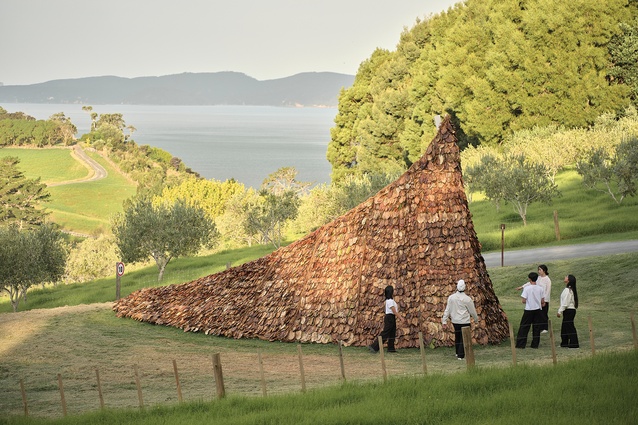
Positioned at the entry to Brick Bay, the Folly is cloaked with 7000 pukanui, akapuka and magnolia leaves.
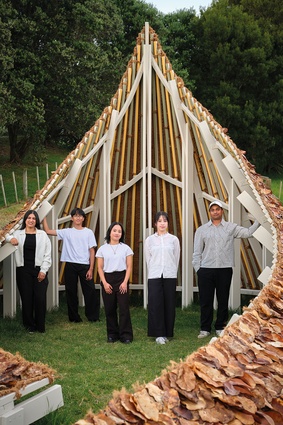
Folly team members, from left: Jasleen Basra, Nyle Macaranas, Rain Nario, Naomi Felicia and Sufyaan Chuttur.
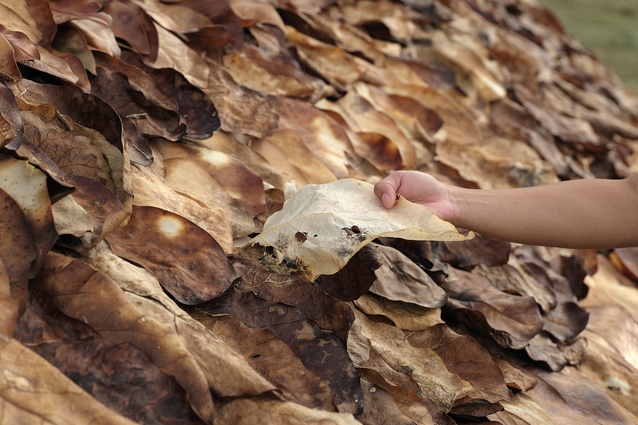
The 7000 pukanui, akapuka and magnolia leaves cloaking the Folly are preserved with coconut glycerine from PureNature NZ.
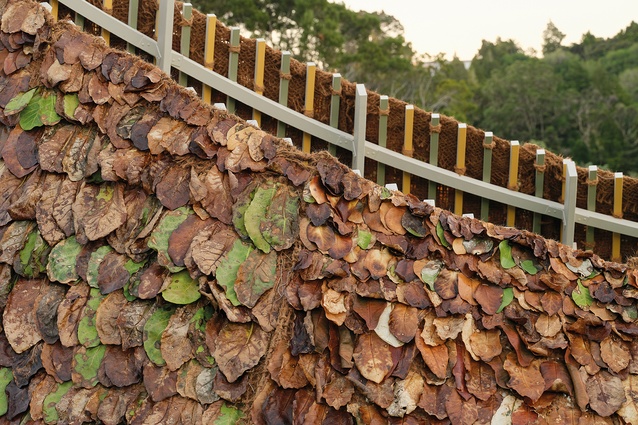
The pukanui, akapuka and magnolia leaves have been hand-stitched to a woven coir backing.
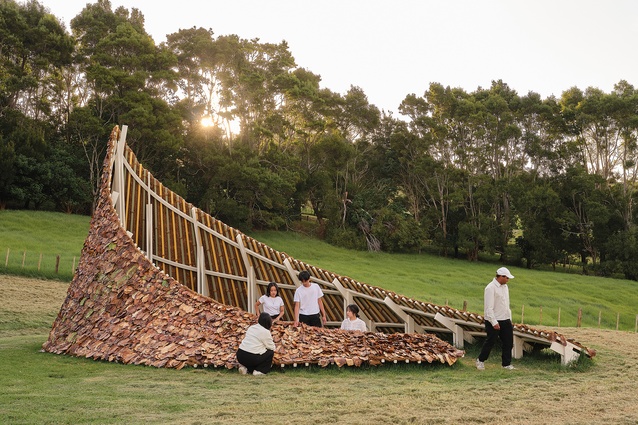
The timber structure was painted in Resene Half Fossil, with battens alternating in Tulip Tree (orange) and Flax (green). The latter two colours reference the life cycle of leaves turning from green to orange.
This year’s winning Brick Bay Folly, Within the Wings of the Kāruhiruhi, will shed its foliage feathers as the seasons pass. Amanda Harkness finds out how the designers have so cleverly woven nature into their project.
Every year, the Folly surprises. It might be the ambition of its team, the thought process in dreaming up the design or the innovative construction approach brought to the table. This year was the first time a team had sought to use materials directly from nature as integral to the build: a cloak of more than 7000 leaves (pukanui, akapuka and magnolia) collected from the environs and painstakingly treated, dried and stored before being laboriously hand-stitched to a woven coir backing. The precedent was a traditional, sustainable building technique of northern Thailand where large, leathery tong tueng leaves have long been used as a roofing material.
The concept for Within the Wings of the Kāruhiruhi, as is often the way, evolved over time — a reflection of the autumnal offerings evidenced in the team’s first visit to Brick Bay in April last year, coupled with an enduring image of the outstretched wings of a pied shag which greeted them as they entered the trail.
“We went out to the site twice, to sketch ideas individually and then convene as a team,” explains Nyle Macaranas. “What struck us all was the transient nature of both the trees and the birds, which, of course, is in line with the transience of the Folly programme itself.”
Three toothpick models eventually became one over a two-week period and what began as a wing soon morphed to a more structurally sound solution following early mentor meetings. “The structure was quite complex because of the number of pieces and its parametric curved form,” says Sufyaan Chuttur. “We had to work out how to retain the architectural elegance but meet the structural demands of the bracing, which required us to innovate a solution — a curved, continuous bracing bending in three directions.”
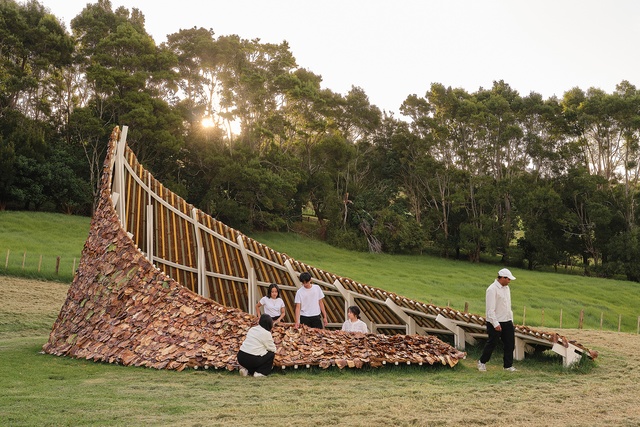
After much material consideration — moving from the originally proposed 45x45mm timber to dowels, steam bending and, even, mentor Pip Cheshire’s suggested bamboo — the team landed on marine ply. “It’s modelled in Rhino and Grasshopper, then pulled out and unrolled like a net, then it’s CNCed out of the plywood sheets and laminated together in four layers,” explains Chuttur.
Layers one and two were laminated at Unitec, under the guidance of Keith Mann, and then taken to Brick Bay to affix to the structure with glue and screws, “because it bends easier at just two layers”. Then the second set of layers (three and four) were laminated onto the curve on site.
“This process was arrived at, thanks to much input from Keith,” says Macaranas. “We had no construction experience and he helped us build a one-to-one model at Unitec, testing and bending the plywood, creating segments from A to G, and cutting 6m lengths where we’d originally specified 14m.”
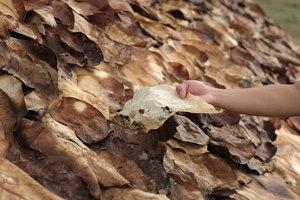
Naomi Felicia, who had discovered the properties of the Thai tong tueng leaves, knew that, even without treatment, the leaves could last for four years on a structure in Thailand. “We realised it would be a challenge to find leaves with the same characteristics here in New Zealand, and that they also needed to be evergreen because we would be sourcing them throughout spring and summer for the build at the start of this year.”
Having landed on the native pukanui and akapuka leaves, along with introduced magnolia leaves, treating the leaves in coconut glycerine to aid in their preservation saw them blacken within the solution but return to their original colour when bleached by the sun. “Mould would grow if they were left in the solution too long or if they were subject to damp while in storage,” says Rain Nario, “so, it was very important to find the right balance of how to treat them, where to store them and how to dry them.”
Both the team and Brick Bay had been keen to use screw piles instead of concrete foundations — as Yellow Post had last year — but were unable to do so within budget. “So we decided to use Flowable Fill,” explains Jasleen Basra, “which is more sustainable than traditional standard concrete.”
Judge and mentor Keith Mann says the team’s defining quality was resilience. “The group faced a number of challenges along the way, including limited construction experience,” he points out. “So, we created a workshop environment where failure was encouraged through mentorship as part of the process and where the team felt safe to test ideas, question assumptions and grow. While resolving parametric forms, one-to-one model-making and hand-stitching 7000 leaves, the team learned that projects succeed because people persist.”
As the project progressed, Mann says a clear shift occurred. “‘Can we?’ became ‘We will’ as they gained authority, confidence and a collective sense of identity, shared responsibility and determination. The Folly itself is designed to weather and decay but the transformation of the team is lasting. Mentorship is ultimately about holding space for the team members to emerge, not as learners seeking permission but as architects making declarations.”
The Folly opened to the public in early May, resplendent in its cloak of autumnal leaves and ready to move through the seasons as if a part of nature itself.
This year’s judges were the late Pip Cheshire from Cheshire Architects, Steve Cassidy and David Killick from Cassidy Construction, Karmen Hoare from Resene, Peter Boardman from Structure Design, Keith Mann from Unitec, Chris Barton from Architecture NZ, Richard and Anna Didsbury from Brick Bay and Oliver Prisk from the 2025 Folly winning team, whose Folly was named Yellow Post. Brick Bay Folly is sponsored by Resene, Cassidy Construction, Cheshire Architects, Structure Design, Unitec, Architecture NZ, ArchitectureNow, Sam Hartnett Photography and Brick Bay.
Entries to the 2027 Brick Bay Folly are now open. Details can be found here. Submissions close 9am, Tuesday 23 June 2026.