A tribute to Pip Cheshire: Pete Bossley
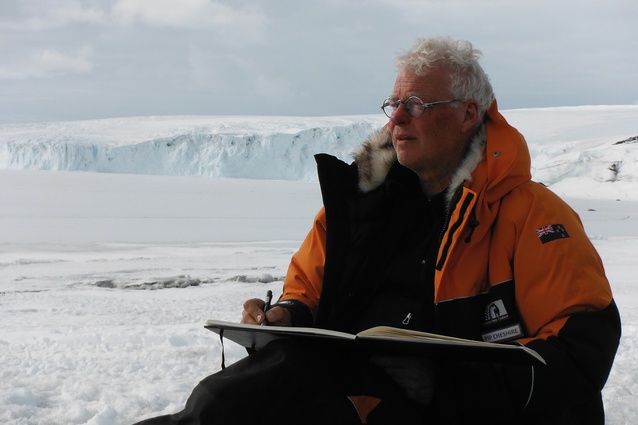
Pip sketching at Cape Evans during the 2014–2015 conservation season.
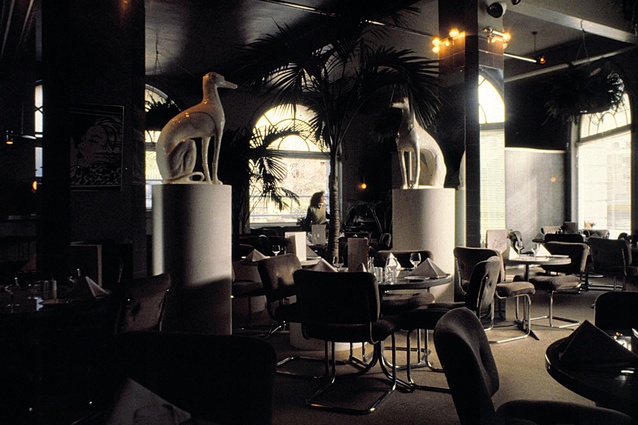
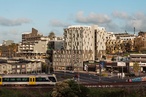
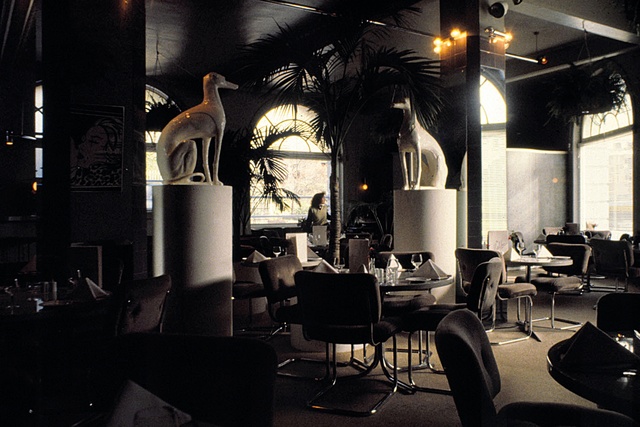
Melba (1980) in Freyberg Place, Auckland.
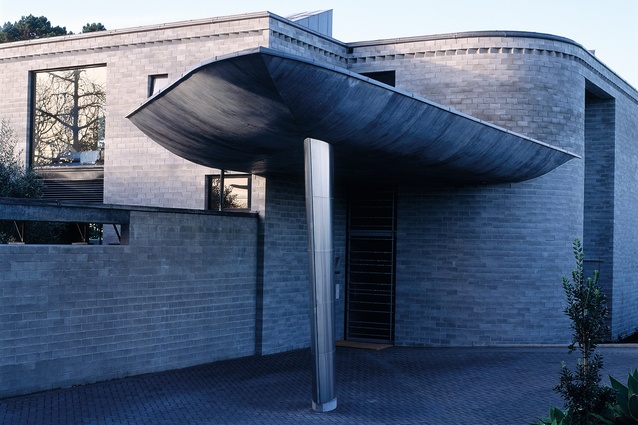
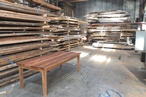
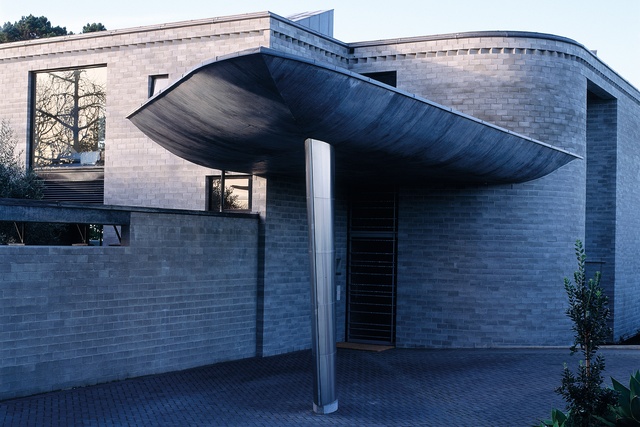
The Congreve House (1992) on Auckland’s North Shore.
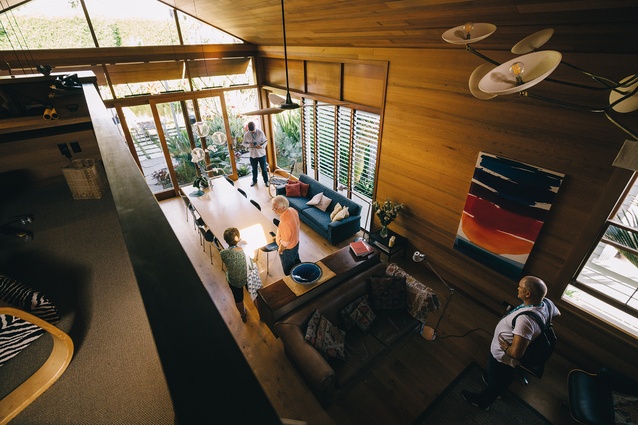
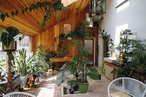
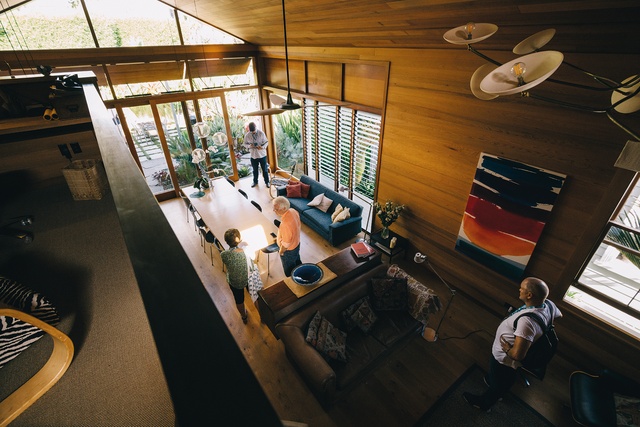
The Cheshire House in Ponsonby.
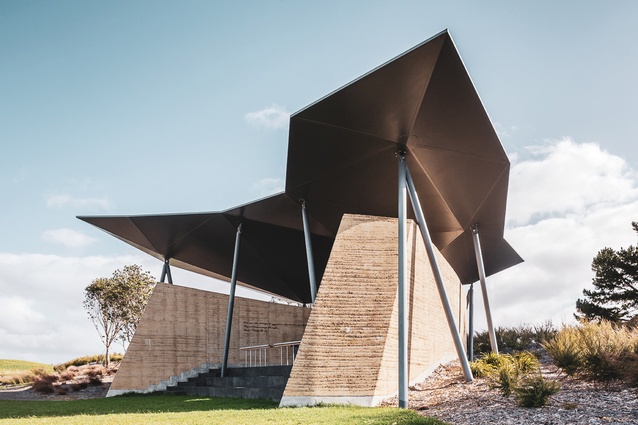
Rore Kahu (2015), Rangihoua Heritage Park.
Pete Bossley, Director of Bossley Architects pays tribute to his friend and colleague.
Notes on a life lived with gusto
David Mitchell. Ian Athfield. Marsh Cook. Now, Pip. Gone. For them, architecture was much more than a profession; it was life. Friendships, family, humanity, social agitation, personal ethics, politics and more, all entwined into a lifetime of exploration, debate, ideas and arguments. An enthusiasm to rub up against authority, to do things differently, to make lives better.
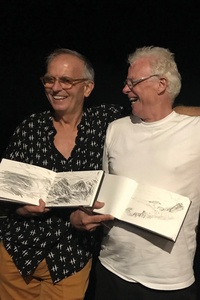
So where to begin? Fifty years of friendship, laughter, a few tears and the occasional argument. Shared joys and fears, a love of risks being taken and a dislike of sorry conservatism, a long-standing mutual respect.
Pip and I vaguely knew each other at the University of Canterbury: his studies political science, mine law/ literature. He was in a jug band and there was an urban myth about his foot being nailed to the stage floor. Not everyone knew it was prosthetic. He made fibreglass furniture and helmets.
We re-met at Architecture School. I remember the huge grin and a large black-and-white checked overshirt. Times were heroic, with David Mitchell and Mike Austin leading the charge, radically interrogating history, social mores, theory and approach. We were in different years but we joked about forming a practice together. A few years later, we set up individual practices with Mal Bartleet, Amanda Reynolds and Ellen Brinkman under the Artifice Studio umbrella. His first project, for friends, was the very stylish Melba restaurant, in Freyberg Place. Many more friendships and projects ensued from that.
Numerous villa alterations, often for young couples with little money and $10,000 Housing Corporation loans. These clients became friends and often repeat clients. Pip’s first seminal house, for the Congreves, followed on from a previous alteration.
Our charge-out rate hovered around $5/hour. We resisted joining the NZIA because of the minimum fee structure which our clients couldn’t afford. After that was revoked, we joined and we began to value the collegial nature of the profession. Once Pip was involved, his input grew, first as Auckland Chair and, later, as President, where he pushed for inclusivism, and helped establish Te Kawenata o Rata to strengthen relationships with Māori design professionals.
We abandoned the Jervois Road shed, moved above a bookshop, then bought a building in Centre Street, behind the then-vibrant Victoria Park Market. Larger space, bigger jobs. Long Friday lunches, where we invited guests and friends to discuss the wider aspects of our profession. Eventually, we curtailed these, as they expanded to more than 30 people and lasted till evening. We wanted to work. Work was fun. We formed Bossley Cheshire.
Meanwhile, we were both growing families. We were neighbours. My daughters and I babysat their kids. Late at night, one of us would cross the fence lines for a quiet Scotch and a supportive ramble.
Pip’s personality could fill a very large room, attracting people with his warmth, humour and conversation. A witty raconteur, he had an anecdote for every occasion, underpinned by his voracious reading and good memory. A round-table session could range from caring questioning of his subject to fist-pumping, melodramatic shouting, fortified with humour and positivity. His voice had a natural depth that carried across a bubbling dinner table with ease but not dominating for the sake of being heard.
He was a subversive. His alter ego, Walter Lego, fired off letters to the papers and various other outlets whenever some outrage needed venting. My version was Roy L. Doulton.
What this points to is the belief in the wider role of architecture. It is not about just buildings, but encompasses human values, social conditions and ethical ideals, and we saw it as an architect’s responsibility to speak out in as many forms as we could.
Often, life seemed to take on the air of battle, maybe resulting from having been short of a leg from birth with the accompanying teasing he got as a kid, or from the mediaeval high-school system he endured at Christ’s College, although that was not a totally negative experience. Maybe it was the constant pain or discomfort the leg caused him. He rarely complained.
One poignant example was when Mal and I assisted him after a long march during the Springbok Tour protests, when we realised his leg was bleeding from the exertion and even he had to admit he needed help.
The sense of battle was ever-present. Arguments were founded, lines were drawn, people were mustered; let combat begin. In meetings, we all knew that, if Pip was there, then sparks might fly: positive energy thrown about like lightning bolts at lesser ideas… creativity was in the house.
Family was huge for Pip. Aileen was a strong voice of wisdom and caring. It was not always easy to ride the roller coaster she lived with. A great team, they raised three boys to different pursuits, from tattooing to government diplomacy and policy advice to art and architecture. And, now, there’s a growing tribe of grandchildren: a vibrant bunch. Their villa in much-loved Ponsonby has great views of the CBD he cared about so much. A recent addition to the rear seems carved from a large block of hardwood: a spacious volume that is as comfortable for a single person to chill in as for 30 to shout and laugh. It seems about to be swallowed by the garden’s jungle-like intensity.
The whānau was extended by the inclusion of long-term neighbours and friends. The bach at Sandy Bay was another haven: one of four huts perched atop a precipitous clifftop. The venture was shared with Mal and Trish Bartleet and multiple other couples: again, friends, children, grandchildren gathered in copious numbers. It doubles as a retreat for Cheshire staff to advance.
Of course, it also serviced Pip’s obsession with surfing: another environment for the battle to rage. He became a master of delicious ink and watercolour sketches, capturing movement and light from around the world, including Antarctica, where he could put down only a brief throw of colour before the brush froze. Recently, we swapped one of my abstracts for his view of my old house from his back garden. Mentoring staff and students was always important.
At Cheshire Architects, he was much loved; at home is a little fold-out card with drawings by staff, sharing aroha for their kaumātua.
He loved to write, with many outlets, such as Architecture NZ and Block. His writings reflected his active vocabulary. He wrote as he talked. He would pound out 1000 words in an hour; editing? what’s that? The result was a red-blooded roam through his expansive memory, vocabulary and insights, unfettered by editorial corrections or norms. Just straight Pip.
Our relationship was rich and enduring. Apparently between us a little rivalry was a valuable thing. He liked to “keep the competition in the room”… to feel we were competing, not that I necessarily realised.
Legend has it that Louis Kahn used to labour at his drawing board, wrestling with ever-thicker layers of graphite, muttering “How’m I doing, Corb?” I didn’t aim quite that high, but almost. Often, I find myself addressing my sounding board: what would Pip think?
Bossley Cheshire ran for only three years before we merged with JASMaD to form Jasmax but, somehow, we became entwined in the public eye; after 30 years professionally apart, we are still occasionally called by the other’s name. Was it Pip Bossley? Or Pete Cheshire?
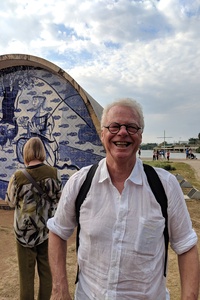
We appreciated the skill and endurance required to achieve a half-decent building, let alone a great one. Architecture needed to be explored in the flesh. A lovely example was the two weeks we spent in Brazil with 14 mates from Architecture School and a few additional friends. With Debora Laub as our local guide, we roared around São Paulo, Rio, Brasília and more: a memorable celebration of fine modern architecture, of vibrant culture and of friendship. Lina Bo Bardi, Niemeyer, da Rocha, Artigas: architecture of soul, rooted in culture.
We can’t address individual projects here but what can we draw from the body of work? For Pip, there was no architecture without clients. It was not an academic pursuit existing in limbo; the ideas that underpinned a project had to grow from, or rather be dragged, sometimes reluctantly, from, debate and arguments. No clean, simple neo-modernism for him but, rather, the messy and sticky and embattled earthiness that ensured the project was dug into place, be that a physical location or socially defined idea.
In the early days, he would underplay his achievements, claiming he was “just trying to get the roof to meet the walls”. In his 2013 Gold Medal interview with John Walsh, he said: “My ego is bigger than my ability”. Not true. Well, at least not the second part.
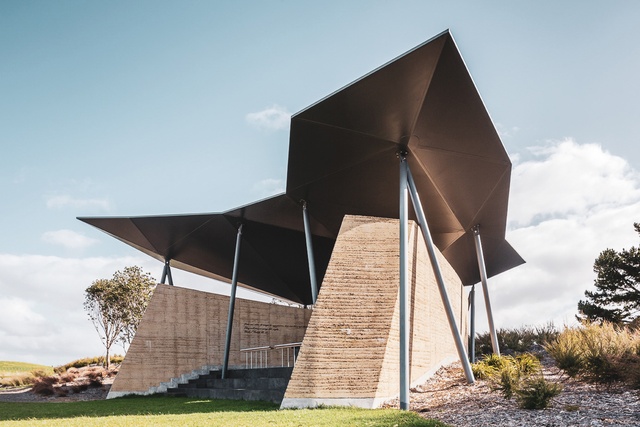
His projects embraced awkwardness in the best sense of the word. Not slick or easily elegant, they were often the result of full-frontal battles with clients or himself. Buildings born of the struggle: “forged in flame”, he might have claimed. For example, the Mountain Landing Hilltop house where the orthogonal timber building suddenly bursts forth with a canting tower of robust stones and window piercings, or the apparently simple Congreve plan, which reveals hidden secrets, or the entry at the Jasmax office where the surfboard-inspired entry canopy teeters in obdurate instability. And, of course, the wonderful Rore Kahu, the Marsden Cross memorial, where elegantly curving rammed earth walls are sheltered by a canopy from another language: angular and mismatched but made entirely appropriate by the vigour of belief driving the design.
I guest-critiqued his last programme at the School of Architecture. He was exhorting the students to “smell” their architecture. This probably confused the hell out of them but, when we look at his work, we can see him saying, “well, modernism demands a clean white wall here. Stuff that; let’s look for something lumpy, something with its sleeves rolled up, something with a good whiff.” The outer wall of Q Theatre is a fine example, where a clean brick façade would have sufficed but, instead, a wrinkled rucked-up wall of rhomboidal interlocking pre-cast forms appeared.
What we can celebrate is the fulsomeness of a life, which happened to wrap around architecture. A life of love for people, connections, ideas and beliefs. A life to be fought for. A battle won.