A tribute to Pip Cheshire: Chris Barton
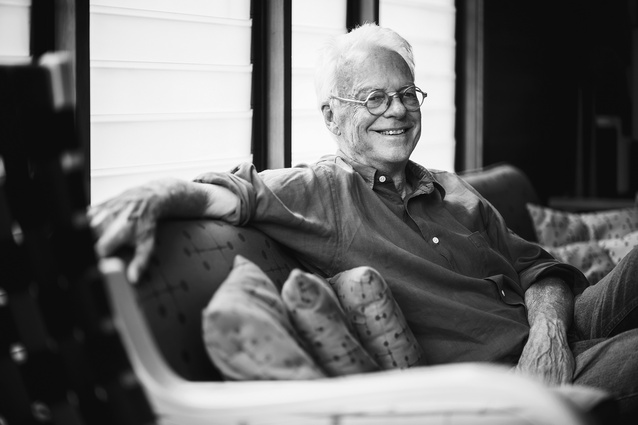
Pip at home, 2025.
Chris Barton, editor of Architecture NZ pays tribute to his friend and colleague.
Goodbye, our friend
When I took up the role as editor of Architecture New Zealand in December 2018, the first person I asked to be a regular columnist for the magazine was Pip Cheshire. His breadth of experience in the field of architecture — accomplished practitioner, former president of Te Kāhui Whaihanga New Zealand Institute of Architects (NZIA), an NZIA Gold Medal recipient, etc. — goes without saying. But I wanted him as a columnist because I knew him as a person determined to make a positive contribution in everything he did, with a deep conviction about the power of architecture to transform peoples’ lives for the better. Plus, I knew he could write, beautifully. He immediately said yes and that he didn’t want any payment. He remained a steadfast friend of the magazine.
His first column (March/April 2019) was a call to action: “The making of housing that is sublime, an efficient use of resources and long-lasting is not beyond our profession. We are, after all, able to do this consistently and beautifully for our individual clients. Alas, no amount of oneoff exemplars will effect the changes to the land and capital apparatus required unless we have a mind to address the vast elephant in our industry that is the ‘national housing crisis’. And why would we not? More than any others, we are the last generalists: able to work across disciplines, to reconcile the chaotic and seemingly disparate in the derivation of excellence. We may, though, need to set down our tools for a while and act a bit more politically.”
His last column (Jan/Feb 2026) before his passing on 11 February was about packing up and moving from his Hobson Street offices of some 20 years to new premises: “As the last cabled entrails were removed and the desks knocked down for transport across town, the memory of all those voices and all those projects fell silent, and I knew the studio was no longer here. A few lingering people gathered up a carload of paintings, and I drove them across town to join the others in the new studio.” His seven years of columns, in his inimitable, deeply personal, richly evocative, rambling, poetic style offered rare insight into, and a vital critique of, the state of architecture in Aotearoa New Zealand. The big issues its architects face.
I particularly loved July 2023 about his conversations with his house — a remodelled villa in Ponsonby: “My house talks to me. It talks of seasons in a language that I barely notice from day to day. It is both a sign language and one of irregular sounds: of distant clicks and slow sighs, often drowned by the clatter of daily domestica. Occasionally, when some activity or another gives me time to pause, I look closely at the changes creeping slowly into the house and take pleasure in measured reflection.” His engagement with the world was vividly visceral. See March 2025 about the difficulties in judging architecture awards: “And so the institute jury is charged with smelling the entries, listening to clients and the sounds of their buildings, the reverberation of footfall and the silent corners, the fall of light, the slope of the land, the juxtaposition of colour, texture and material, the patterns of its use and occupation and, yes, even the smell of the building. Buildings are an exchange in which the architect is but a bit player.”
Pip was also the first person I approached in 2014 about collaborative Masterslevel studio teaching at the University of Auckland’s Te Pare School of Architecture and Planning. He said yes and so began a regularly repeated collaboration. The last design studio we taught together was in 2025 about developing a site in Auckland’s Britomart. He was a born teacher with a natural ability to encourage and inspire students in a profound way. He was incredibly dedicated and caring, telling students to email him over the weekend if they needed more feedback. His emails back were a delight to read.
Feedback to one student: “I love the idea that the building might be founded on something that moves with the tide, that groans and creaks as the central part of it swells upward according to lunar influence — bravo.”
He understood the theatre of pitching a project. “I think it would be good to abandon the cellphone,” he told a student. “Even notes on a sheet of paper is a better look, but better you get to speak without notes. Remember that no one in the audience knows the building as well as you.”
He did simmering outrage quite well, especially when questioned by an accreditation panel about what planning-based instruction was given to students. “I spoke to all students about the way that the city shapes itself through planning controls and discussed my role in the generation of Britomart’s controls. I pointed out the importance of maintaining unimpeded views of the heritage parapets… and noted the difference between Quay Street buildings west of Queen and those east.I referred to Hugh Ferriss drawings of Manhattan planning controls,” he replied reasonably before going in for the kill.
“I also noted that in many respects the planning controls were backward looking and constantly evolving as the city grows, and that as budding architects they should have in mind their city in 50–100 years hence and propose solutions that may contravene existing controls but having in mind issues of urbanity, heritage, civility, etc.”
Always patiently passing on his knowledge and experience. Always willing to give back. Always determined to make sure the culture and future of architecture in this country is robust, diverse and in good hands: that was Pip.