To draw is to err
Karamia Müller considers how drawing is more than proof. It is a practice of negotiation: wrestling with ideas, with clients, with materials, with time.
Reader you may recall an earlier column I wrote, which, in turn, invited rebuttal. I remember writing it at the tail end of 2022. And here we are in 2025, with the debate on AI now omnipresent. Some regard it with the fervour of the newly radicalised, as if mania — or revelation — lies just on the other side.
I’ve gone a way myself. Provoked by an invitation to argue against the motion at the Rendered Futures debate on AI and LLMs in architectural drawing, I was thrown back again into thinking about AI. The motion: “This house would adopt AI and LLMs to enhance drawing practice in Aotearoa.” And, so, I embarked on another small study, more philosophical than technical, on what AI is and what drawing does. I considered more deeply what we are taught in architecture school: that drawing is not only an artefact of architectural intention but also a process. And, more specifically: drawing is the space where ethical error becomes possible.
As I thumbed through old sketchbooks, I found my own drawings full of error: lines too long, a pencil smudge that blurs. The mistake that lingers. A drawing that breathes because of it. How lucky are we to worship in such a church?
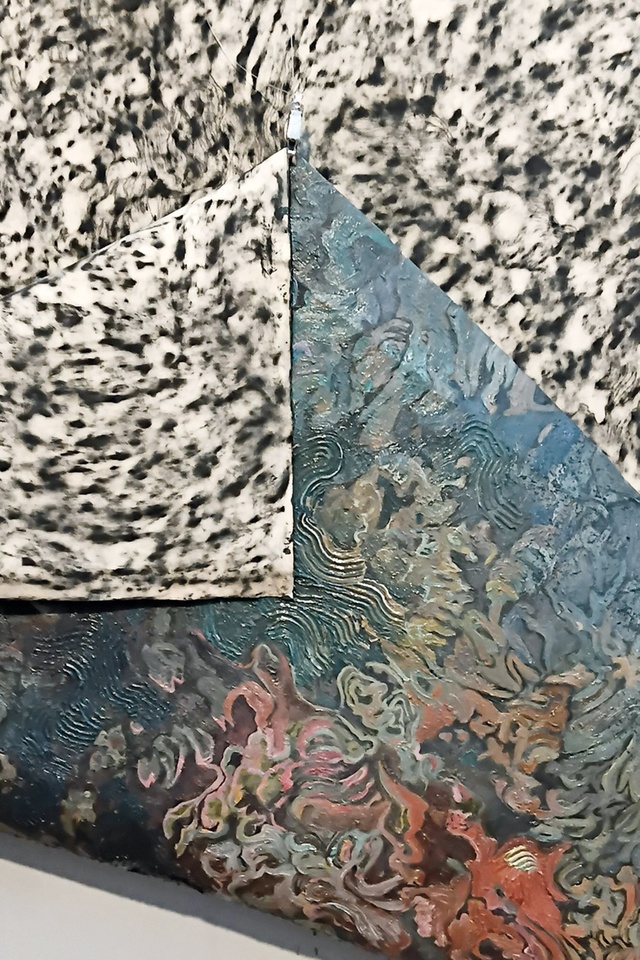
Come the evening of the debate I stood clutching my notes. Behind me stretched a drawing by architectural theorist, pedagogical scholar and practitioner Sarah Treadwell: a kind of taliswoman. Her epilogue, above, another.
I felt grounded by its presence. In a room full of architectural drawings and practitioners, I argued that we should not embrace artificial intelligence in architectural drawing. Not without deeper questioning. Especially not if that embrace requires relinquishing our capacity to be with uncertainty, to be with tension, or to be with the care that drawing enables and holds for us when those things take hold.
When I think about drawing, it matters because it allows us to err. And the mistake, that human, unresolved gesture, is where meaning, particularly that which is architectural, begins.
At times, it feels as though we are living in a moment of seductive, aspirational acceleration. Blinking in the light after Covid lockdowns, it is almost as though we re-entered the world primed for speeding up, making up for those slow years, with our time, our bodies, our relationships.
This perpetual momentum is embodied in generative AI tools like Midjourney and Dall-E, which can produce hyperreal architectural images in seconds. They simulate light, depth and atmosphere, without touch, without weather, without waiting. The sky in these renders often shines a perfect-hole-in-the-ozone-type blue, not unlike the patch of sky I used to gaze at while writing these columns in lockdown. When I last prompted Midjourney for urban buildings, it produced amnesiac rhomboids. I recall my student days, trying to wrap materials onto spheres in rendering engines: the awkwardness, the trial and error — perhaps this is the architect’s Black Mirror.
Contrast that with the slow burn of the Rendered Futures exhibition: the space of fragile, human drawings that staged the debate. Here, drawings weren’t just instructional tools. They were time and space, and they held pause, doubt, fantasy, life. They refused the perfection of AI-generated images. They held uncertainty rather than smoothing it out.
And their meanings were layered. They communicated not only architectural intent but something more intimate: the dream, the hope, the risk of the hand. AI may be made in our image but it cannot hold our ambiguity. It may reflect us but it does not metabolise us. When I consider the fervour with which some debate AI, I think of this and feel calmed.
In Atlas of AI, theorist Kate Crawford reminds us that AI is not artificial and it is not intelligent. It is made of rare earth minerals, human labour, vast amounts of energy and scraped data. Every render, she writes, is made of something: metal, water, precarious labour.1 AI does not exist in the cloud. Its amorphous sentience lives in the mine, the factory and the ever thirsty, ecologically compromising server farm.
It is not weightless. It is not neutral. It is of the land, the whenua itself.
And therein lies the rub. As long as AI is treated as just another ‘tool’, we skip over the conditions of its existence: extraction, bias and the epistemic violence that it demands. When AI is trained on colonial, racialised and patriarchal datasets, what kind of architecture can it imagine and what sorts of drawing must precede that architecture?
Political economist and Professor of Philosophy, Kohei Saito, proposes that capitalism justifies all destruction in the name of human aspiration. It does not matter if the planet burns, disappears, evaporates, so long as growth trends upward.2 In AI discourse, we see this logic retold: the promise of optimisation, of output, of efficiency, at a price so abstract it becomes invisible. But what if faster is not better? What if the erasure of the human hand, the hand that hesitates, that fails, that revises, all because the human does, is not aspirational but a profound loss?
I return often, not only here but as an affirmation practice, to pedagogical scholar Sara Ahmed’s writing on discomfort. She argues that ethics and learning begin in the space of unease: the moment we slow down, listen and question. In drawing, that space is the ‘error’, the unresolved, the tentative, the flawed.3
Drawing is more than proof. It is a practice of negotiation: wrestling with ideas, with clients, with materials, with time. And, in that wrestling between the erasure and the redrawing, architecture emerges, not just as product but as process: a process that mirrors our own fragilities.
Architecture isn’t about just perfect form. It’s about the care of people and place, and that kind of care emerges only through difficulty, through the mirroring of humanity.
The pathway towards that mirror ought to be just as human. When AI generates a drawn artefact on command, it is not imagining. It is averaging. It gives us hallucinated spaces drawn from the top of the bell curve, from the mean, trends and data points. But those conventions are not neutral. They are racialised, gendered, economically loaded. They reflect the aspirations of the few at the expense of the many.
To draw is to step beyond the mean. To claim time. To hold doubt. To make space for those excluded from optimisation.
In Aotearoa, where architecture increasingly engages with Te Tiriti, we must resist tools that erase complexity in favour of certainty. To do otherwise is to abandon relational ethics for algorithmic skies, not the wonderful one we have.
Perhaps that is why I still return to the drawing made by our own humanity. Not from a dodo-like sentimentality but because the drawing, especially the imperfect, unfinished one, is a site of refusal.
To refuse the bell curve.
To refuse automation where error is necessary.
To refuse solutions before listening.
I think of the drawings, and teachings, of Sarah Treadwell, which permit, nay, invite, ambiguity, breath and multiplicity. I am fortunate to have them as quiet companions to these thoughts: reminders that not all marks are meant to be final. Some are meant to linger.
May we all find the moments to linger, reader.
May we all fail and find ourselves richer for the lesson. May we care. Reader, may we draw.
References
1. Kate Crawford, 2021, Atlas of AI: Power, Politics, and the Planetary Costs of Artificial Intelligence. Yale University Press.
2. Kohei Saito, 2020, Capital in the Anthropocene. Monthly Review Press.
3. Sara Ahmed, 2004, The Cultural Politics of Emotion. Edinburgh