The man who thought language was a house
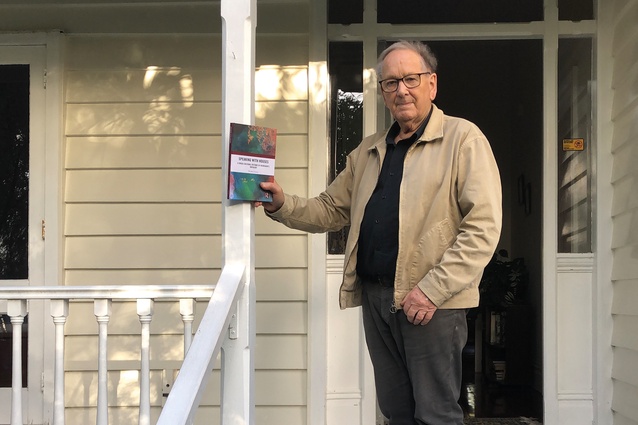
The author, Dr Michael Linzey, former teacher of architectural design and theory at the University of Auckland, with his book Speaking with Houses: A Cross-Cultural Critique of Heidegger’s Ontology, Routledge, 2025.
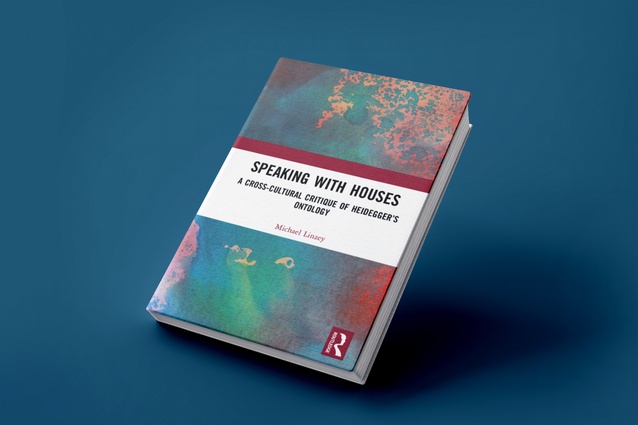
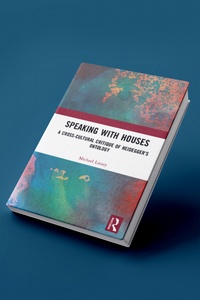
Speaking with Houses: A Cross-Cultural Critique of Heidegger’s Ontology, Routledge, 2025.
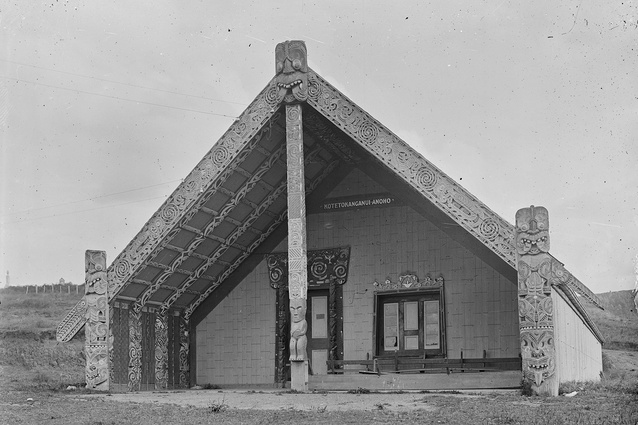
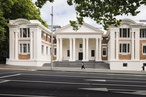
Te Tokanganuia-Noho Meeting House, Te Kuiti, 1917.
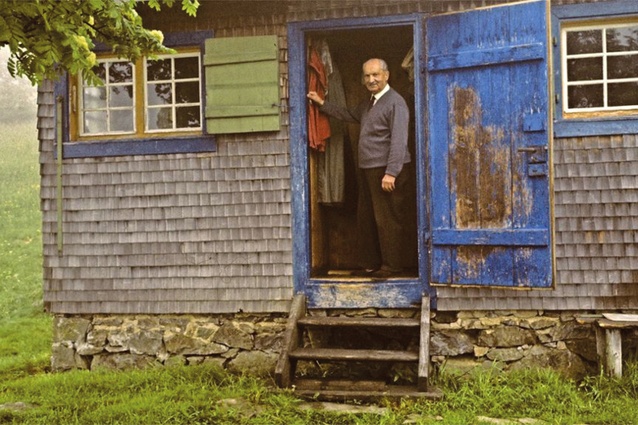
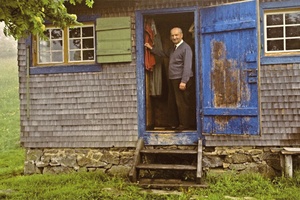
Martin Heidegger in der Hütte in Todtnauberg.
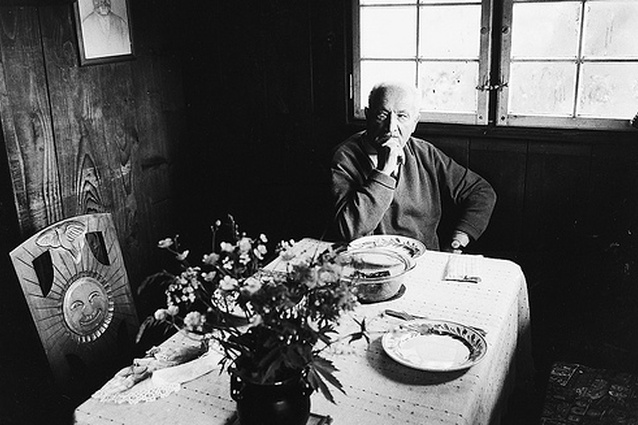
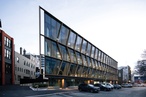
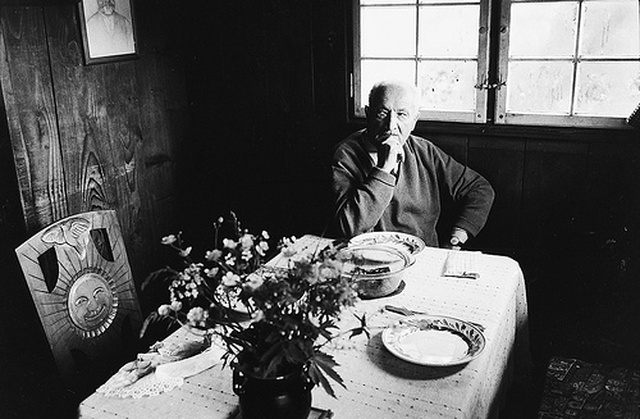
Martin Heidegger in his cottage dining space.
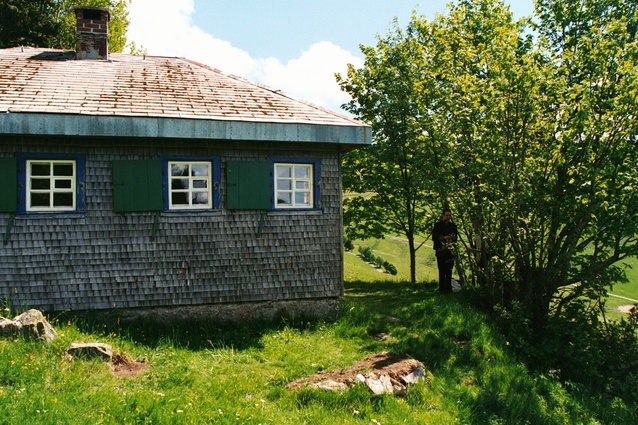
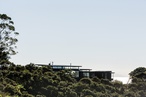
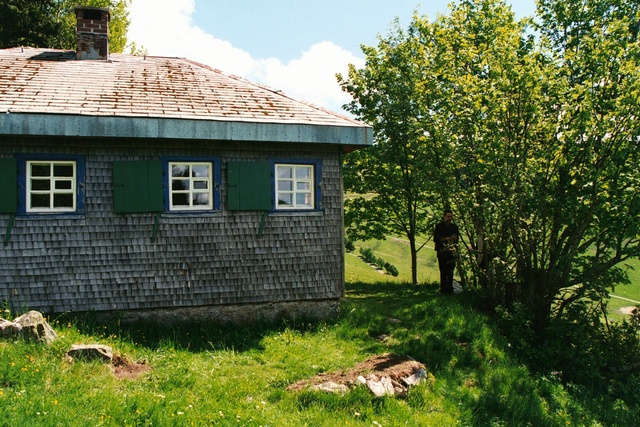
Martin Heidegger’s cottage.
Academic Michael Linzey presents a new view on Martin Heidegger and the meaning of Being in his latest publication, Speaking with Houses, a short book that was published late last year by Routledge.
Architects are familiar with Heidegger mostly because he wrote Building Dwelling Thinking in the 1950s. Architects build houses; we all dwell in houses. And a very few philosophers and poets think about the houses that we build and in which we dwell together.
My book looks at Heidegger’s other writings beyond this single essay. His major contribution was to affirm that architecture is a poetic art:
“Man does not dwell in that he merely establishes his stay on the earth beneath the sky, by raising growing things and simultaneously raising buildings. Man is capable of such building only if he already builds in the sense of the poetic taking of measure. Authentic building occurs so far as there are poets, such poets as take the measure for architecture, the structure of dwelling.”
The major philosopher of architecture in classical times was a little-known figure, Cleanthes of Assos (331–233 BC). Cleanthes was the second head of the Stoic school in Athens. He is best remembered today for a poem he wrote called Hymn to Zeus, in which he outrageously claimed that the father of the Greek gods was also the architect of the cosmos. It is less well known that Cleanthes also wrote a dissertation about urban design. Here, he declared that there are three ways in which the Greek language addresses the polis. I argue Cleanthes’ architectural philosophy led Vitruvius, two centuries later, to formulate his famous triad: firmness, commodity, delight — firmitatis, utilitatis, venustatis, in the Latin language.
Cleanthes’ philosophy of architecture was followed by an outpouring of beautiful cities, fine buildings, animated sculptures and sublime poetry that we call Hellenistic art. I hope, and believe, that Heidegger’s poetic philosophy will lead to a similar outpouring of beauty in modern art and architecture.
We are also familiar with Heidegger in relation to National Socialism. When he wrote Being and Time, in 1927, he seems to have believed that Dasein, or Being-in-the-world, could serve as an ontological foundation for the Third Reich. A human being is not an isolated subject, observing an external world in some detached and objective way. Instead, we are already politically embedded, thrown into and fully committed within it. But, as Hitler and his cronies rose to grotesque power, Heidegger’s political philosophy was promptly ignored in favour of state terrorism and actual warfare.
After the war, Heidegger was subjected to a brutal programme of de-Nazification. He survived the interrogation with his life but he was deeply wounded by it. He retreated to a remote cottage at Todtnauberg in the Black Forest, where he rethought the main lines of what was to become his substantial new philosophy of poetic architecture.
In 1941 Heidegger had written that “Language is the house of Being.” I argue that this clumsy-seeming image, this deliberate conjoining of words, “language” and “house”, was architectural poetry. Like “Zeus is an architect”, like the triadic language of the polis. Language-house was a clear-sighted observation on Heidegger’s part that there is something deeply wrongheaded about the Western world’s obsession with Being.
Years later, in On the Way to Language, he wrote: “Some time ago I called language, clumsily enough, the house of being. If human beings, through their language, live as they are called upon by being, then we Europeans presumably live in a very different house than the East Asians do.”
For, by this time, Heidegger had set out to study other world languages more closely. He attempted to translate the Tao Te Ching into German, for example, and, when he failed to do so, he was forced to acknowledge that there are other languages, other “language-houses”, other cultural architectures in the wider world, and that only the Western languages would find service as a house of Being.
Cleanthes and Heidegger each founded their philosophy of architecture on Aristotle’s poetics. Before Cleanthes came to Athens, he had lived in Assos, a beautiful hillside town in what is, today, western Türkiye, that looks out on the island of Lesvos. In this archaic polis, Aristotle had established a peripatetic school where the young Cleanthes, perhaps, received his early education.
When Heidegger wrote that “language is the house of Being”, he was deliberately introducing a poetic image into his discourse. He was looking forward, he said, to a day — which had not yet come to pass — when philosophers would comprehend the poetic significance of the language-house image.
“The talk about the house of Being is no transfer of the image ‘house’ to Being. But one day we will, by thinking the essence of Being in a way appropriate to its matter, more readily be able to think what ‘house’ and ‘to dwell’ are.”
And this “more appropriate” thinking, Heidegger hazarded, will embrace what Aristotle had called poīetic language. At some time in the future, he said, “man will dwell poetically on this earth.” Heidegger was announcing — but, as yet, only in a preliminary way — a new venture and an exciting new “adventure”, when thinking about architecture in terms of the poīetic language of building and dwelling, would heal the wound of humanitas. And here, Heidegger reaffirmed his allegiance to Aristotle:
“I shall mention poetry now only in passing. It is confronted by the same question, and in the same manner, as thinking. But Aristotle’s words in the Poetics, although they have scarcely been pondered, are still valid – that poetic composition is truer than exploration of being.”
Heidegger acknowledged that language-house was a poīetic image — a blue-sky speculation about the thinking that is to come — and he concluded this essay with another sky-image:
“Thinking gathers language into simple saying. In this way, language is the language of Being as clouds are clouds of the sky.”
The central principle of Heidegger’s philosophy of architecture was poīesis. Poīesis is the art of making images. Aristotle had said a builder draws images of a house. A physician draws images of good health. And we make our most striking images when we simply draw two or more words surprisingly together. If the images are striking, they will be memorable, like thunderbolts, bolts from the blue. Yet, the image itself is simply and merely an unusual copulation of words in the language of the everyday. A poīetic image actively and strikingly draws together two or more words which, otherwise, would have remained separate.
Hence, the centrality of drawing in architectural practice. If we think of the word ‘drawing’ as an active verb, not a passive noun, not an object nor the representation of an object but an active adventure with architectural ideas, then drawing can be the poīetic drawing-together of something new. “Language is a house.” “Zeus is an architect.” “Cumulus clouds are an Opera House.” “A rose is a Concert Hall.” “An office building is a gherkin.”…
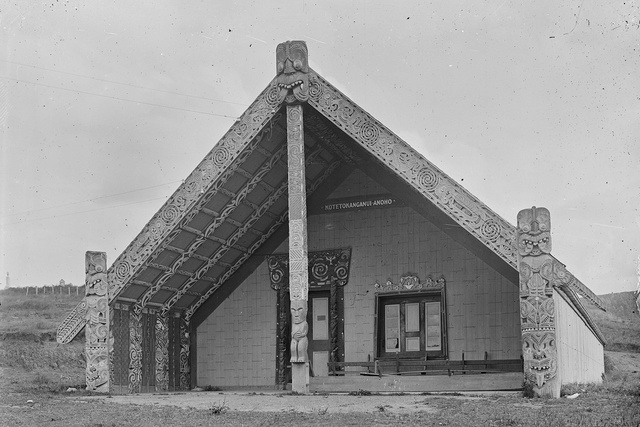
Here in New Zealand, we are located at the extreme limit and as far away from the centre of empire as one can get. Māori architecture is different from European architecture. The continuing tension and contestation between Māori and Pākehā that we call biculturalism or post-colonialism or confrontation with the hegemony can also be understood in architectural terms as a creative polemos between language-houses.
Te Tokanganui-a-Noho is a wharenui, a large and significant house at Te Kuiti; it was built under the direction of Te Kooti in the early 1870s. It is, perhaps, the oldest fully carved meeting house standing today outside of a museum. As such, it represents the beginning point for an excited outpouring of architectural experimentation and creative adventures: all the new and poetic kinds of languagehouses that are springing up all around us today.
Language speaks, Heidegger wrote in 1950, and architectural language speaks through the poetry of its significant houses:
“Language speaks. If we let ourselves fall into the abyss denoted by this sentence, we do not go tumbling into emptiness. We fall upward, to a height. Its loftiness opens up a depth. The two span a realm in which we would like to become at home, so as to find a residence, a dwelling place for the life of man.”