Student rooming
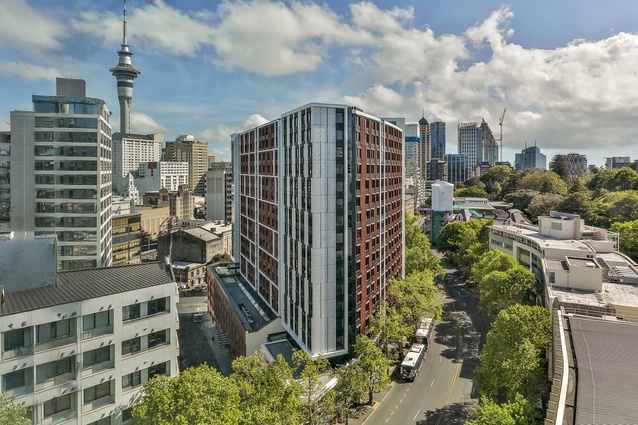
UniLodge Auckland Central is located at 66–72 Lorne Street, at the southern end where it intersects Mayoral Drive — on the edge of Auckland’s ‘Learning Quarter’.
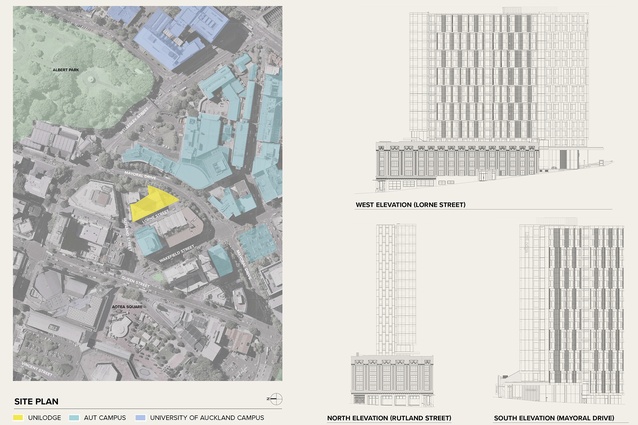
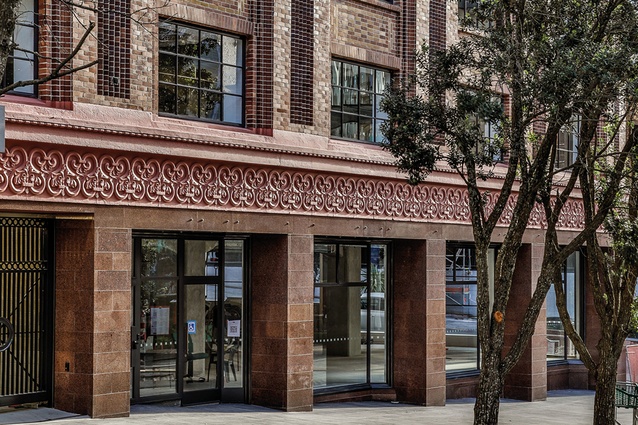
The façade of the existing building has been preserved, the steel windows retained and an ungainly canopy on Rutland Street removed to reveal the original terracotta frieze.
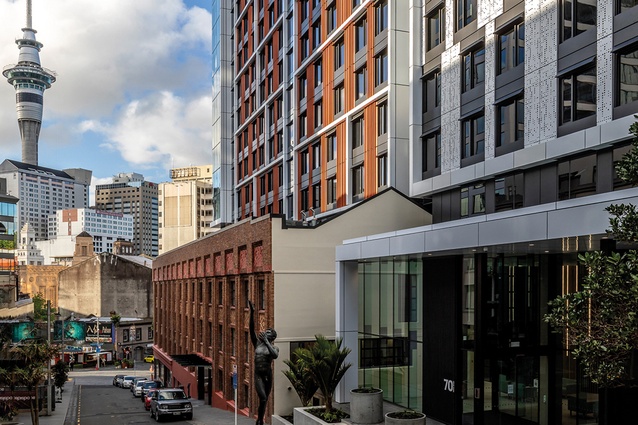
Lorne Street is a key pedestrian route between the city centre and the AUT campus.
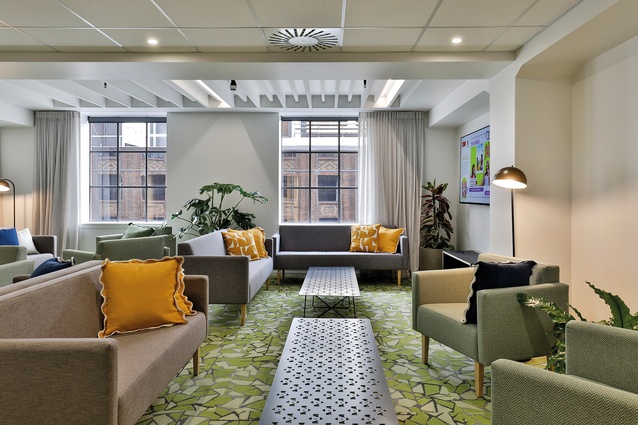
A communal lounge on Level 1.
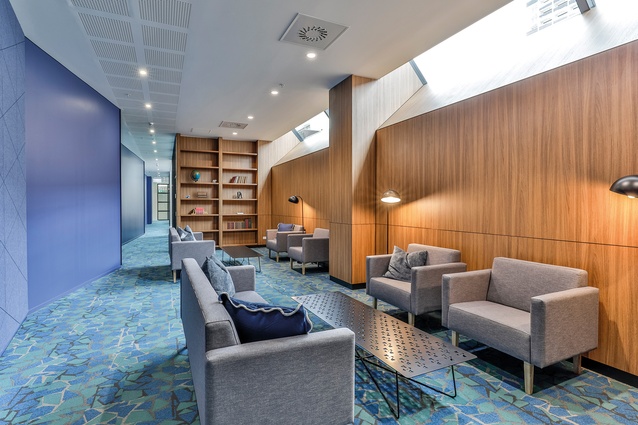
The ‘library’: skylights have been cleverly added to daylight these otherwise landlocked spaces.
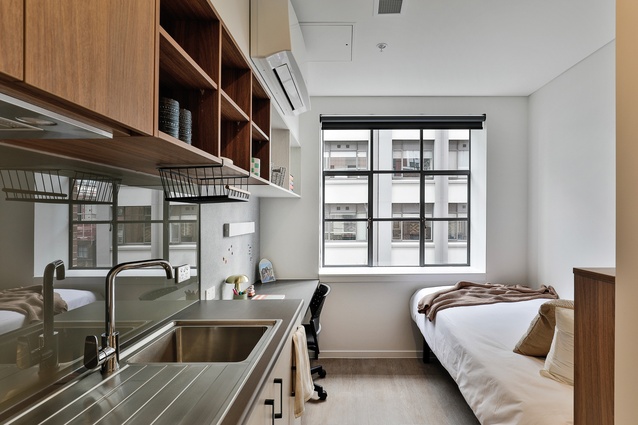
A studio on Level 1, facing Lorne Street, with steel windows of the existing heritage façade.
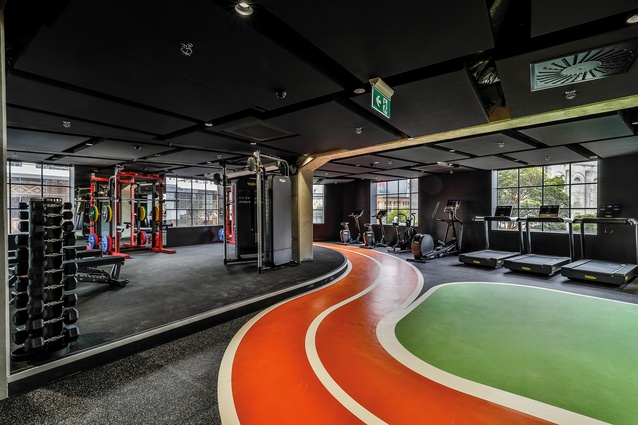
A 220m2 gym reflects current students’ greater interest in fitness than in alcohol.
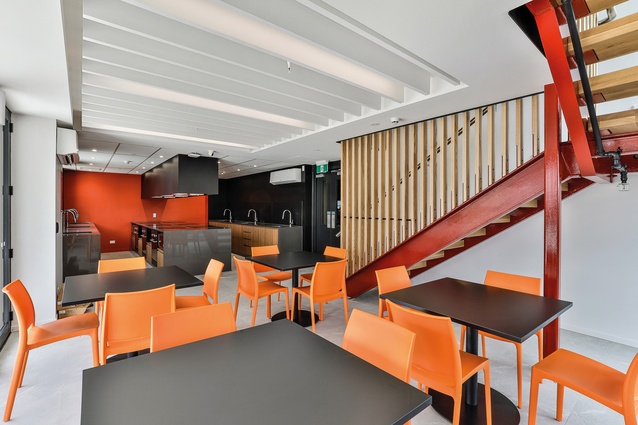
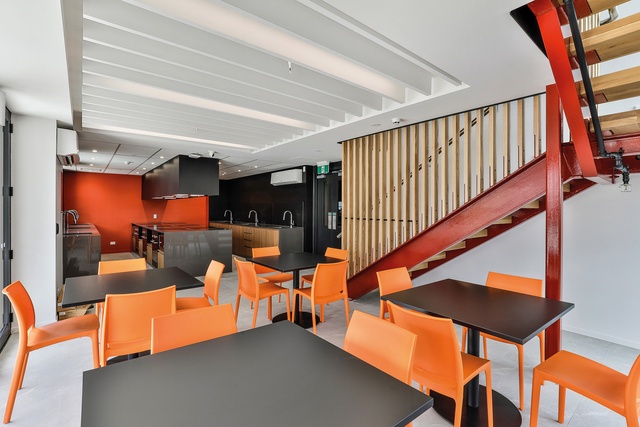
The Level 2 communal kitchen faces onto the upper terrace.
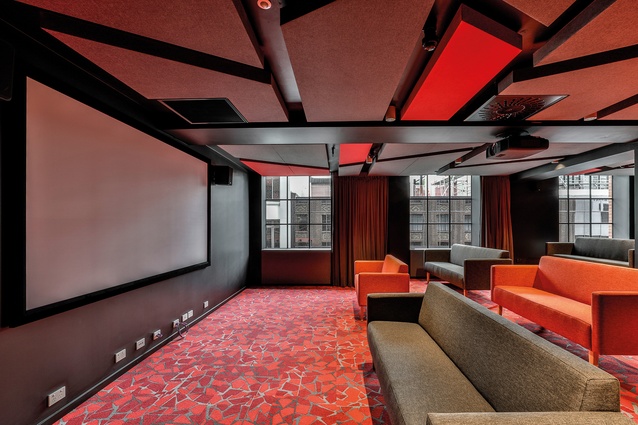
A communal theatre has couches but not beanbags, which experience has shown will ‘walk’.
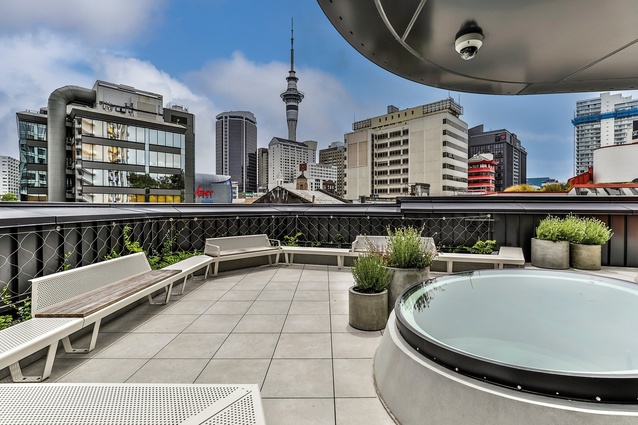
The development has two courtyards.
Jon Rennie investigates UniLodge Auckland Central by Ashton Mitchell and the evolving ethos, scale, location and social architecture of university student housing and the lifestyle it engenders.
Architecture pratice Ashton Mitchell is not new to student housing — the Lorne Street building operated by UniLodge is its fifth completed and it has a further two breaking ground. Director Clifford Paul has extensive knowledge of their design — Lorne Street is his third and he regularly works with the University of Auckland on post-occupancy evaluations through user-group workshops.
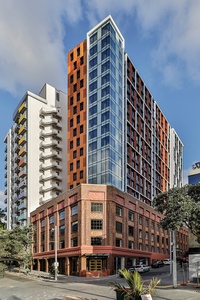
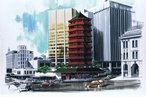
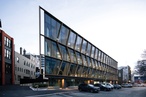
UniLodge Auckland Central is located at 66–72 Lorne Street, at the southern end where it intersects Mayoral Drive, on the edge of Auckland’s ‘Learning Quarter’ — the campuses of the University of Auckland and Auckland University of Technology (AUT). The project integrates a new 19-storey accommodation tower above an existing heritage building and has recently achieved a NZGBC 5-Green Star Design and As Built NZ v1.0 certified rating.
There are 758 beds within the development. A few are in ‘apartments’ — four-bedroom units, each with en suites and a shared kitchen and dining area — but the vast majority are individual studio units with their own kitchenettes, study desks and bathrooms. It is not expected to be favoured by many first-year students seeking a halls experience and catered meals but, rather, by students, predominantly in later years of study, seeking more independence. At this scale, the facility can support full-time staff and amenities — a café, gym, theatre, two music rooms, a hobby room, study rooms, breakout areas, two outdoor terraces and lounges with pool and table tennis tables along with a 60-seat communal dining area with double kitchens.
UniLodge Auckland Central is the latest in a market response to the shortage of student housing in Auckland. Gentrification, increased house prices and Healthy Homes legislation have resulted in a reduced supply of tenancies for students throughout the inner city. Coupled with this are housing providers’ responses to the 2019 death of a student in a Canterbury hall of residence that went undiscovered for many weeks. The result is facilities with a greater focus on pastoral care.
Paul is genuinely interested in the typology, its evolution and the experience of the residents.
He clearly knows what he is doing. As Paul told Anne Gibson of The New Zealand Herald: “You don’t want to be their parent, but you also want to ensure they have a good experience and are safe and happy.” His diligence is evident in the planning of the building and in where he places the ‘energy’ of the project — primarily it is in the community-focused areas and facilities that encourage students to socialise, not to isolate in their rooms.
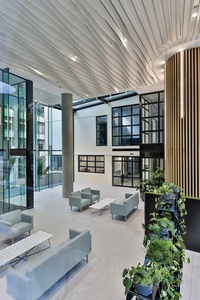
For Ashton Mitchell, the project started in 2018 when approached by property investor Cedar Pacific to assist with development of the Lorne Street site. Design, construction and the interruption of the Covid-19 pandemic (common to all projects over this period) led to construction being completed in 2025. Preparations have been under way since then to receive the first student residents for the start of the 2026 academic year.
On the site was an existing Category B-listed brick heritage building, which has had a long and varied history. Originally a coach-builders, where vehicles were assembled on one floor and sold on the other, it has also been used as a dance hall, a factory for Fisher & Paykel manufacturing, Housing Corporation offices and, most recently, classrooms for ACG Senior College. While no heritage fabric of the interior remained as a result of these earlier uses, the decorative brick façade, its steel windows and contribution to both Lorne and Rutland Streets were highly valued in the building’s listing.
To the rear of the building were several land parcels “cast off” from the construction of Mayoral Drive between 1974 and 1985, resulting in what Paul describes as a “Bermuda Triangle” of urbanity — an absence of city where little happened and the edges to Mayoral Drive were poor. The first design move was to extend the site to include these parcels — enabling the new development to address all three sides of the block.
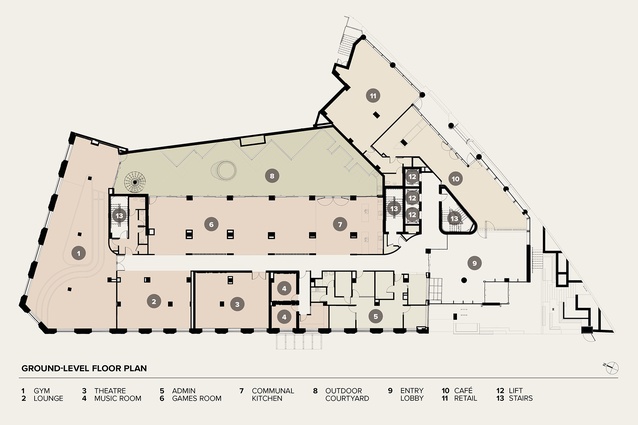
The second design move was to mass and position the tower sympathetically to the heritage façades and, then, to arrange the programme so that all block faces are positively engaged with. The result is a building with three separate ground floors — the student housing addressing the corner of Lorne Street and Mayoral Drive, a commercial floor addressing Lorne Street and a further commercial floor addressing the corner of Lorne Street and Rutland Street.
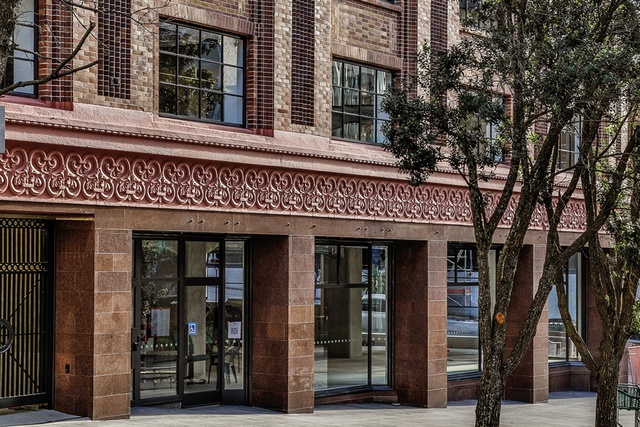
The collaboration by the team with Heritage New Zealand and Auckland Council heritage officers has been productive. The façade of the existing building has been preserved, the steel windows retained and an ungainly canopy on Rutland Street removed to reveal the original terracotta frieze. The new tower is clad in contemporary materials that complement the existing bricks and the vertical modulation and expression contrasts well with the horizontal emphasis of the heritage façade. An initial design proposal to place an outdoor courtyard directly behind the Lorne Street façade was resisted by heritage officers. The redesign and omission of the courtyard led to an alignment of bedrooms with existing windows, which is much more sympathetic to the existing architecture and provides the most appealing studio units in the development.
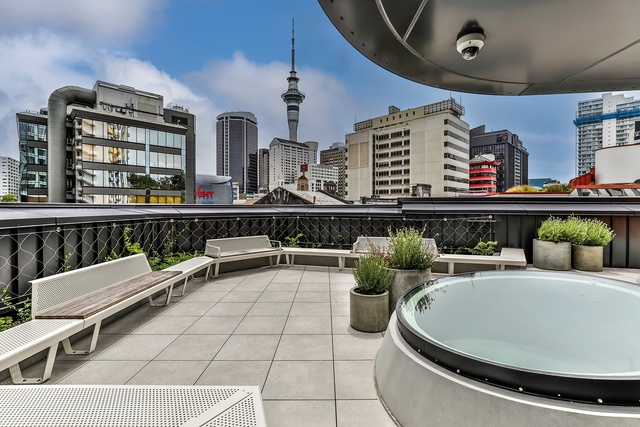
Positioning the main entrance at the corner of Lorne Street and Mayoral Drive works well in giving the other ‘ground floors’ their own identities and the potential to be tenanted by programmes not directly related to student housing. It also enabled Ashton Mitchell to design a contemporary entry that is ‘of’ the tower, distinct from the heritage building. The foyer is double height with provision for a café and the security lines have been carefully considered to provide a controlled-but-welcoming threshold into the building. Access cards are fundamental to the architecture — usage is monitored and, most importantly, lack of use alerts staff that residents are not active and should be checked on.
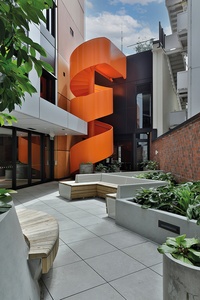
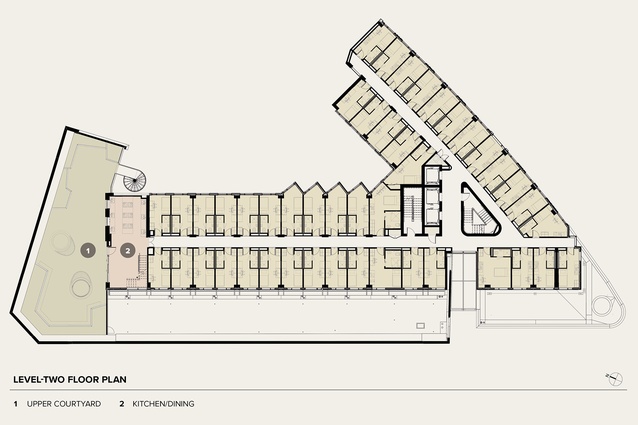
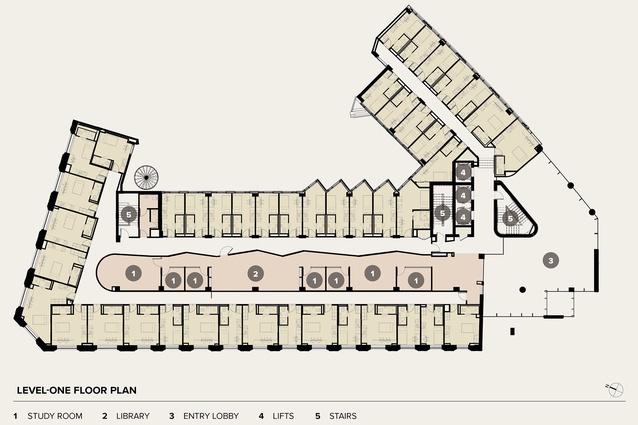
Communal social spaces are predominantly on this ground floor, with quieter study spaces, meeting rooms and ‘library’ on Level 1. Here, western skylights have been cleverly added to daylight these otherwise landlocked spaces. Levels 2 and 3 have lounges at the northern end, which overlook a terrace on the roof of the heritage building. Set below the parapet, this is a generous landscape and communal space. A spiral staircase connects it externally to the terrace on the ground floor below.
It will be interesting to see how this typology does evolve, where the ambition grows and where the future opportunities lie. While the area devoted to communal spaces at Lorne Street is admirable, most of these spaces have a scale and a volume that don’t reflect the number of occupants they host. The precedent of residential dining halls — ‘Great Rooms’ — with double-height space and the opportunity to connect across floors has not been taken. With the removal of 10 Level 1 studio rooms, the games room and communal kitchen on the ground level could have become a great room and benefited from afternoon sun though the western skylights over the library and study rooms.
What will remain in this evolution is the constant tension in these sorts of heterotopia projects — within and between: the public and the private, the personal and the communal, the city and the university campus. The Lorne Street communal areas — the meeting rooms, the maker space, the café – replicate what is available (literally) across the road at the Sir Paul Reeves Building at AUT and Tāmaki Pātaka Kōrero – the Auckland Central Library (and it has actual books and a borrowing system). There appears to be a risk – much like the ‘barista points’ in contemporary office tenancies – of the private duplicating the public and the street and the city suffering as a result.
From Level 3 up, the floor plan repeats, with the communal lounges at the northern end replaced by the four-bed apartments. These 13 floors are doing the heavy lifting of occupancy, with approximately 50 beds on each level — an intensity that must put pressure on the centralised vertical circulation (three lifts and two fire stairs) during peak times of usage.
These floors have typical studio rooms — models refined through iteration by Ashton Mitchell (sadly not photographed). For $442 a week (full-year price), a student gets a 2.7m-wide room that is approximately 4.5m long. Down one side is a wardrobe (with storage for suitcases over), kitchenette and study desk; the other side has a bathroom (WC, sink and shower) and a king-single-sized bed. The window is openable and the supply and exhaust for individual mechanical ventilation is incorporated well in the window head.
Each kitchenette has a 1.4m fridge with a freezer, a double ceramic hob and a microwave — giving students freedom to cater for themselves.
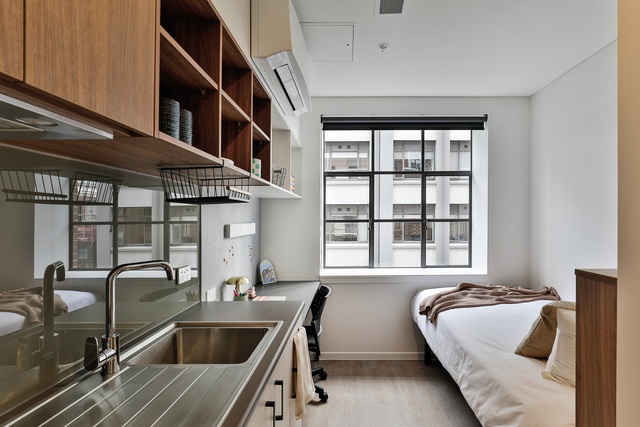
Some residents benefit from bespoke layouts and more space, thanks to the nature of the floor plate, but all have identical bathroom cubicles (prefabricated in Australia). Apparently, current students have more interest in fitness than in alcohol (hence the gym on the ground floor), which is a relief as the prospect of spending the mornings of orientation week hungover in these small, mechanically ventilated cubicles wrapped around a toilet seat would — for the author — be a new definition of hell.
By the time this article is published, the first semester of 2026 will have started and UniLodge Auckland Central will be occupied by more or less 758 residents — all test-driving this social condenser. With Paul, we will watch how the building is received by the students and how the spaces are used, looking for ways to refine the architecture further.