Light box that pops
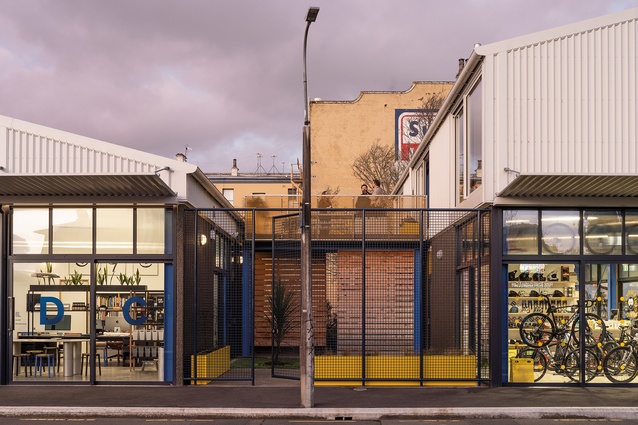
The intersection of the retail and workplace on the ground-floor, and the apartment above.
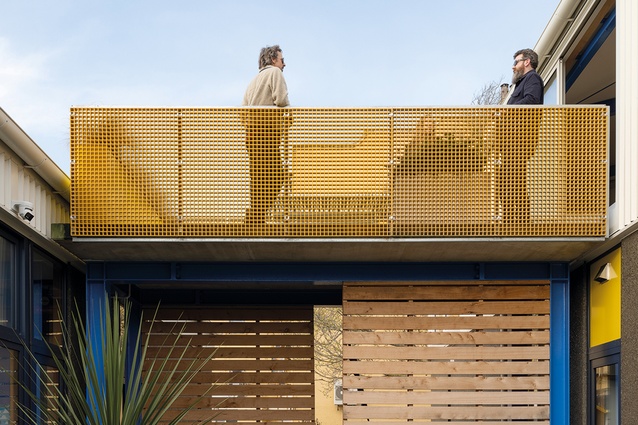
When you get up close, the building expands; as the plan narrows, proportions change so that the sense of vertical space takes over.
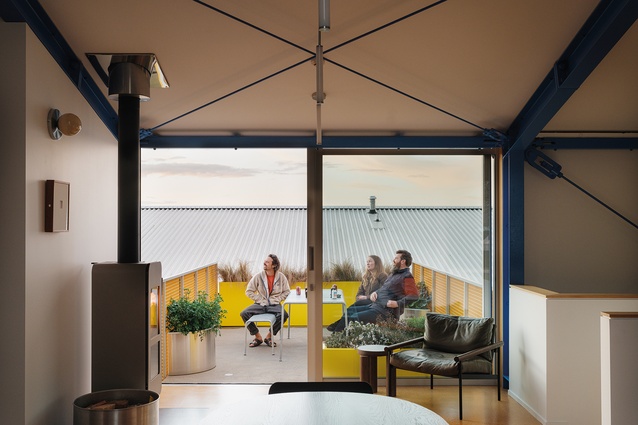
The apartment balcony floats out between street and green space, on a marooned pre-cast panel, encapsulating the notion of the stranded urban dweller.
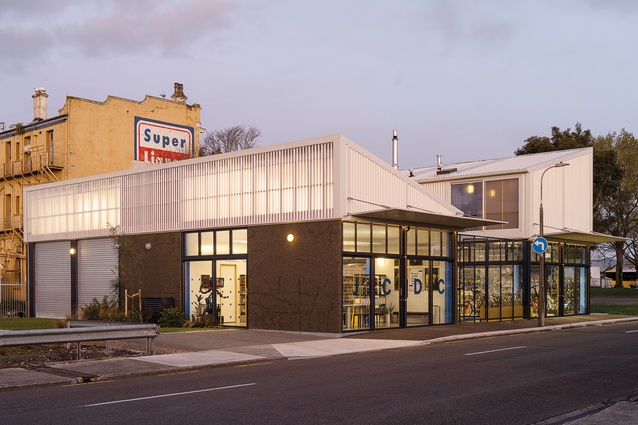
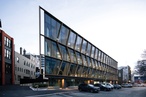
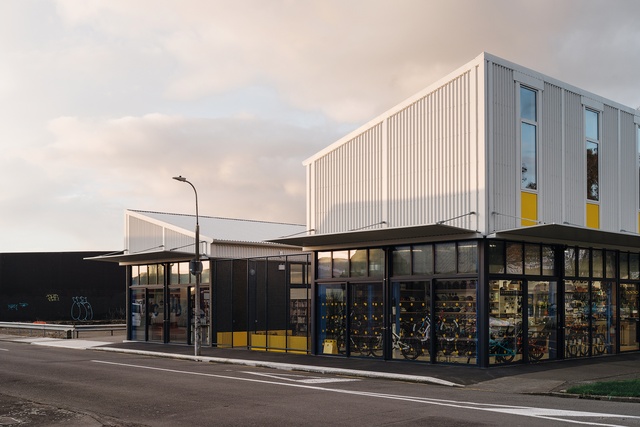
View from the corner of Main and Domain Streets. This building is light, blue, see through: a light box on the corner.
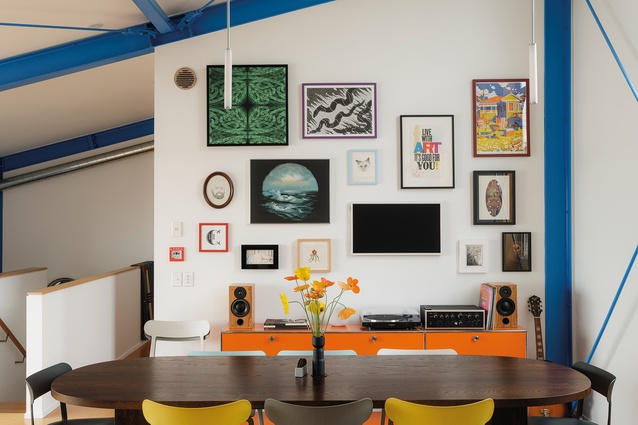
Interior views of the apartment dining space.
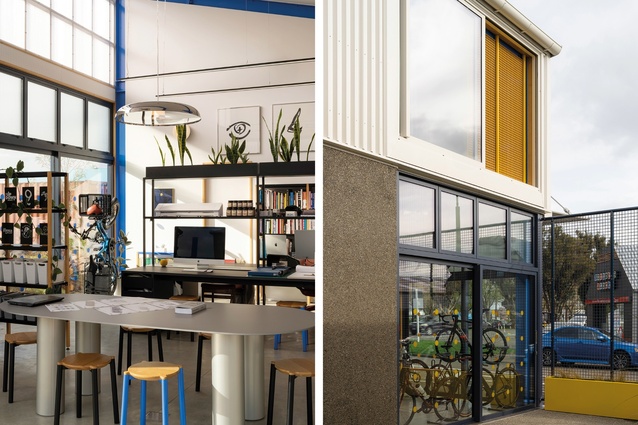
The double-height volume of the studio is flooded with light that completely infiltrates the interior.
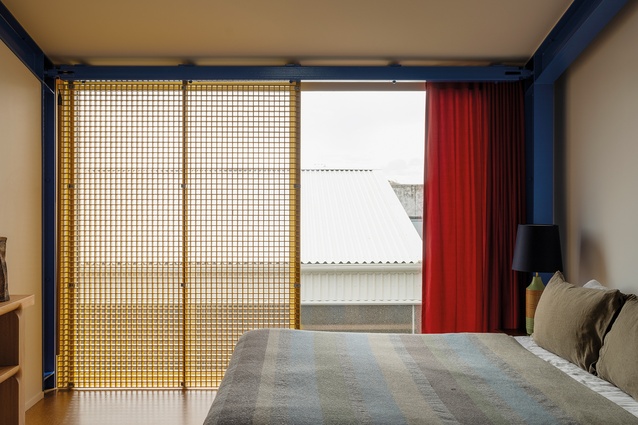
Interior views of the apartment bedroom.
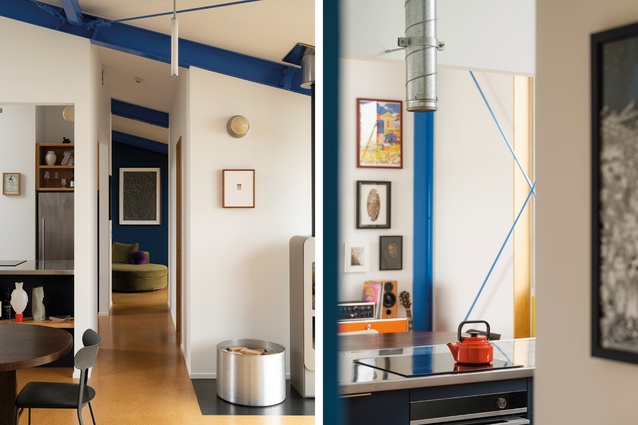
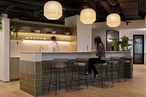
Interior views of the apartment show the kitchen and dining space.
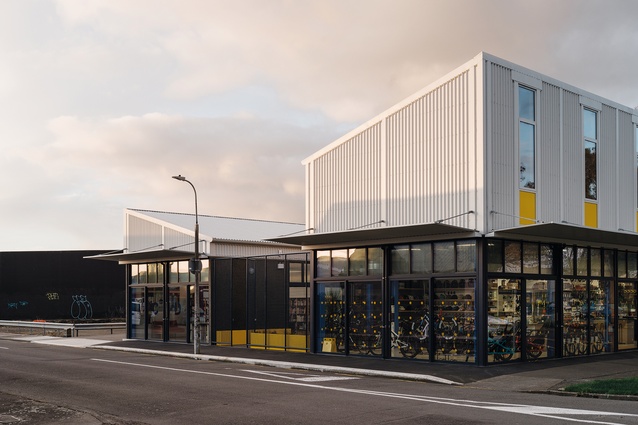
Located on a corner site, the ground-floor retail and workplace tenants of this mixed-use project activate the streetscape while, above, the apartment is designed for adaptive re-use.
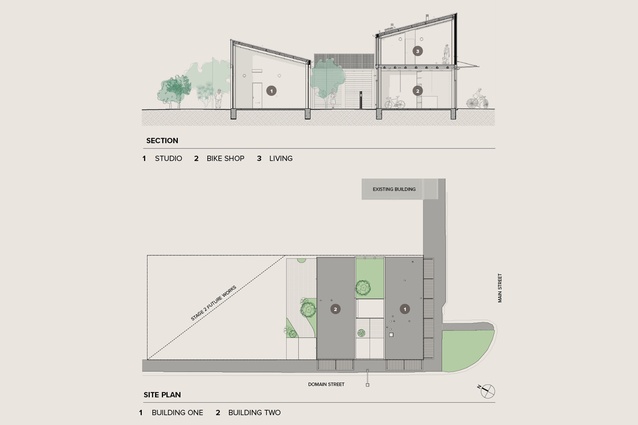
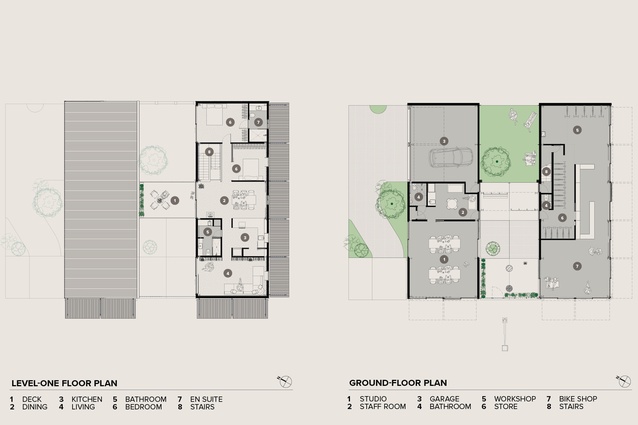
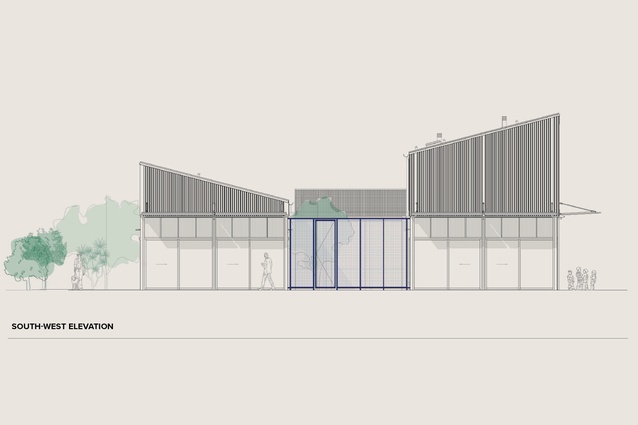
Felicity Wallace discovers Strip Mall, winner of the Sir Miles Warren Award for Commercial Architecture at the 2025 National Architecture Awards and a new presence in Palmerston North, comprising a graphic studio, a bicycle shop and an apartment, by Spacecraft Architects.
If you zoom out on a map of Te Papa-i-oea, you understand how beautiful it is… the edges are green, swirling around the foothills of the Tararua Ranges. To the west is the Manawatū River. You can make out the grid with The Square like some kind of compass, messaging survey lines into space. Main Street is a soft mauve on my map, and the colour in summer is gold in the parks, irregular marks of nature.
When you zoom back in, you understand why Top Gear’s Jeremy Clarkson said: “If God had got it right, Jesus would have been born in Palmerston North…”
Roads reign: straight, wide, circling, double lane, wide bends, roundabouts, race tracks.
So many roads, so few trees, so much mass. It is hard to imagine how this place once was a clearing in a forest. It is easy to stay on the asphalt and miss the forest remnants, the waterways still winding underground, across streets, behind backyards.
Palmerston North, like its namesake, presents a paradox: ostensibly a town of hard surfaces. Explore the interior further and landscapes of suburban living expand: tree lined streets, corner dairies, gardens appear. Streams and soft ground meander the borders of backyards. The grid becomes a guide back into the bloodstream of the city.
While the pattern of the grid is static, the experience is active: the whole city agitates. Cars, buses, bicycles, walkers, trains all ride the grid: this city is a small industrial hub, and a university town, connected to agriculture, connected to the military, linked to the capital city.
The urban buildings are heavy, rendered and, later, brutal — with postmodern plastered pieces; the Turbos’ stadium is chunky and shaped; churches are gabled with towers like chimneys.
The city grew steadily during the 20th century, driven by the central location, topography and government investment, retaining earlier Edwardian and Art Deco influences.
There is free form to follow, with Athfield’s library invading the former DIC department store; and the Craig Craig Moller light sequence extending the clock tower in The Square.
Main Street races into The Square, no longer mauve but grey, grimy, gritty: past The Warehouse, past Resene, past the skate park, the old railway site now a wide park.
The real action/living happens down the side streets: narrow sheltered streets a jumble of small-scale industrial, commercial and residential units.
This building is light, blue, see through: a light box on the corner. The titania long run cladding is insubstantial and the awning detailing tips up a fine edge so that the first floor appears to be floating.
Strangely, the blue aluminium joinery to the streetfront matches the colour of the road signs… the dark-blue aluminium frame connects to the artery of Main Street.
Council planning requirements dictated some relationship with the neighbouring Railway Hotel, a heritage site; this is neatly arranged with height alignment and window articulation. Viewed from across the park, the new Strip Mall is a bright box with spandrel panels that pop.
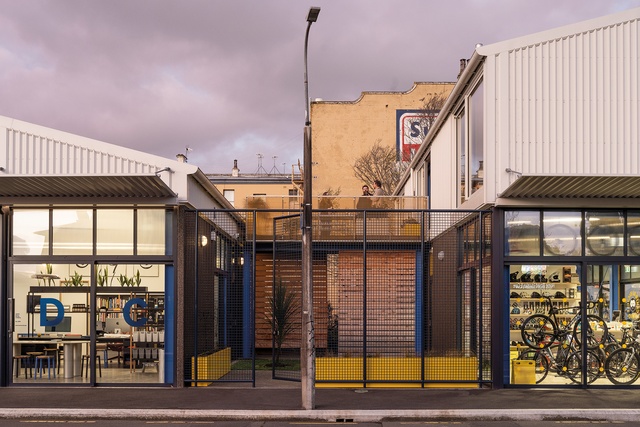
Down the side street, it fits in… Initially, the owners, Adam Curry and Jemma Cheer, working with Colspec Construction, planned to build two separate buildings running north/south along the site, separated by a landscaped area which linked visually across the highway to the old Railway Land park.
Fortunately, they realised their limitations early in the design phase and approached Spacecraft Architects with a brief to create a mixed-use development to include a graphic studio, a bicycle shop and an apartment with a garage.
The first decisions the architects made were fundamental to the success of the project. They turned the buildings around to run east/west along the speedway of Main Street, and created a module that related to the scale of the side street.
A second building block alternates with landscaped spaces, maintaining the module. This maximises sun, allows light and ventilation, and creates shelter from the wind.
The pattern allows for future development along narrow Domain Street: further combinations of building then landscape, building then landscape.
The alternation meets the Council landscape requirements while the small scale kept construction costs down and allowed the project to be staged.
When you get up close, the building expands; as the plan narrows, proportions change so that the sense of vertical space takes over. The volume of the interior space surprises.
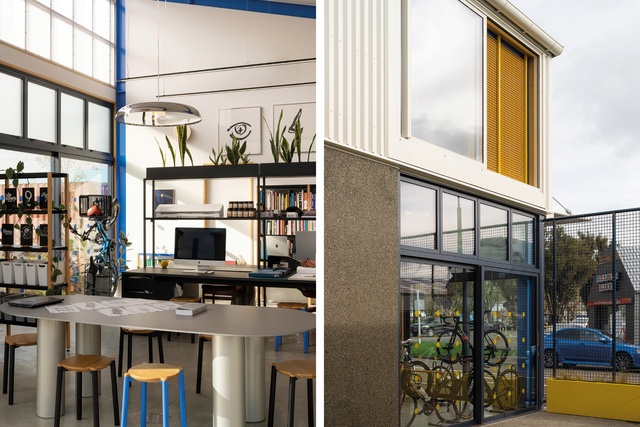
Each tenancy has a distinctive quality of light which defines place: the double-height volume of the studio is flooded with light that completely infiltrates the interior while the back-room spaces — staff and utility rooms — are darkened: almost completely separate interior spaces.
The bicycle shop expands horizontally, with fully glazed walls aligned with the street edge, level with the pavement, turning inwards for repair work.
Above, in the apartment, a sense of depth and privacy is created by controlled and directed light: openings are wide and low to the north, screened with gold fibreglass mesh, while singular vertical awning windows control views towards the park.
Again, the success of these spaces relies on the grid module and the interplay between each segment. The play of the plan is apparently simple when viewed in 2D, endlessly varying in 3D, and delightful to move in and around, up and down. The experience is hard to photograph: a kind of Snakes and Ladders played with depth, light and volume.
Material selections emphasise textural contrast: smooth steel and plasterboard, painted to contrast, set against cork flooring, rubber, vinyl, stainless steel surfaces and plywood cabinetry. Colour deepens in withdrawing rooms to strengthen the sense of privacy.
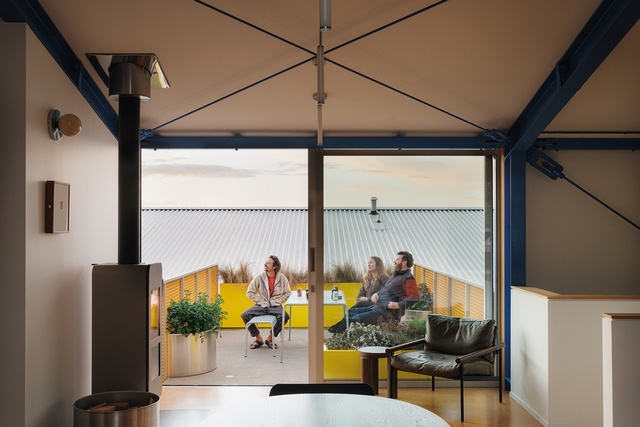
Light fittings, furniture and fittings are carefully and personally arranged to create vibrant and comfortable living and working spaces. Heating and ventilation rely on openings and screens, with a bionic wood fire on the first floor.
The exterior presents a pragmatic, low cost, low rise structural solution to an urban corner site: nothing to distract from the race track of Main Street. Complexity and depth are created as the forms give away to void, light and shade on the side street. Perforated fibreglass screens to the courtyard share views of sculpture and a timbered seat, with a glimpse of garden beyond.
The apartment balcony floats out between street and green space, on a marooned pre-cast panel, encapsulating the notion of the stranded urban dweller. The owners planted native plants in a circle within the dedicated green space and the future forest has grown wildly, creating a private cosmos, an entire world bursting out from the module: a shady, leafy and sheltered respite from the hard urban environment.
The site along Main Street is windswept and the afternoon sun is fierce. The tension between display and visibility has not been resolved by the decision to fully glaze the southern and western walls of the ground floor bicycle shop. Fitout challenges encouraged the owners to add graphics to the glazing.
The shallow streetfront awning, while providing some protection to joinery and soft detail to the façade, is ineffective shelter against the wind and sun. Here, some depth and relief could help moderate the pedestrian experience.
Alongside, the penetrations into the Edwardian Railway Hotel cut the wind, while the fine iron verandah offers shade. Mass remains dominant in Palmerston North, grunge city of Te Tai Hauāuru, but small green shoots are climbing back.
The Strip Mall holds its own against the heavyweights of Palmerston North: a light and fresh line along the Main Street circuit, breathing with the side street, sharing space with the forest.