Ignite. Adapting In the Age of AI: A review and kōrero with Dr Deidre Brown
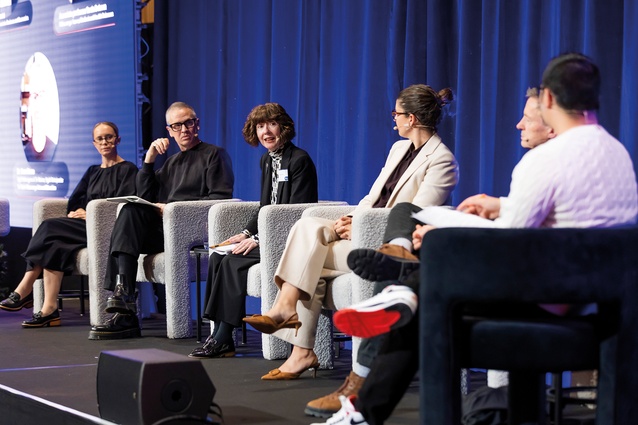
From left: Rosie Dobson, Sean Sturm (Ngāti Rakaipaaka), Deidre Brown (Ngāpuhi, Ngāti Kahu), Alexandra Andhov and Michael Witbrock, with panel moderator Daniel Xu.
The first event in the University of Auckland’s speaker series Ignite. Adapting in the Age of AI opened with a keynote address by Sir Ashley Bloomfield, followed by a panel discussion featuring six speakers: Dr Deepika Jindal (HR), Dr Rosie Dobson (Health), Prof Michael Witbrock (Technology), Dr Sean Sturm (Music), Prof Alexandra Andhov (Law and Business) and Dr Deidre Brown (Māori Art and Architecture).
The panel was asked, “What are the problems and barriers for AI to deliver its full potential?” The question was aimed at teasing apart regulation (and the lack thereof) in Aotearoa. The discussion acknowledged the need for a nuanced approach to thinking about regulation that could not simply be a ‘one-for-one adoption from overseas thinking’. As Dobson noted, this is particularly important, given Te Tiriti o Waitangi and the cultural diversity of our population.
For example, as Brown and I would later discuss, further consideration would be required of Waitangi Tribunal cases such as Wai 262, which addresses cultural Intellectual Property. Wai 262 and Te Tiriti would compel regulation to have a rigorous and critical view on the potential impacts, risks and challenges regarding AI and taonga Māori.
As we know, AI scrapes the internet to generate its imagery, often without considering intellectual or cultural property, the material’s context, history or whakapapa. This automated extraction poses a direct threat to the very concept of kaitiakitanga.
Naturally, the conversation switched to the concerns about potential ramifications of AI on the job market and workforce, raising the ‘AI versus Human’ discussion.
Jindal spoke about the ways in which the job market values ‘T-shaped employees’: “those with deep knowledge in one area, but broad knowledge across several things”. This emphasises that great employees can connect across disciplines, lead with empathy and curiosity, and possess the wisdom of “when to lean in and when to let go”, effectively building bridges across roles and sectors. Thus, it describes the ‘human value’ still brought to the job market and reinforces critical thinking as a hallmark of humanity.
Brown reinforced this perspective through what she is witnessing within the Architecture School and the wider profession. She noted AI’s competency as a tool that extends (and speeds up) the efficiency of computational tasks such as rendering or creating moving visualisations. Conversely, AI is, currently, struggling to produce working drawings from these visualisations and is certainly unable to perform the complex task of spatial rationalisation.
Similarly, iwi organisations are now using generative AI to articulate early visual aspirations, before the formal engagement of an architect. Yet, what AI cannot do is perform what Jindal described earlier: to think across sector boundaries and connect the dots. This is the heavy, multifaceted task of the architect, well beyond the visualisations the public often expects: managing compliance, legal/regulatory frameworks, aesthetic considerations, socio-political impacts, cultural responsibilities, historical context, materiality and regenerative design.
Brown also described how the emerging digital divide, and a growing talent gap, is potentially further exacerbating accessibility issues. A divide is emerging not just between those with access to (and the funds to access) the ‘right’ tools but, equally, between those prepared to embrace AI’s potential and those who choose not to.
Ka mua, ka muri.
In our kōrero after the panel, Brown and I discussed some of the notable gaps in the event’s conversation. The first was a complete lack of engagement regarding the environmental and ecological impact (both potential and actual) of these tools. A simple search will spell out Google’s own plans to build three nuclear reactors dedicated to the energy required to power its AI data centres, or the basic cost of fresh water required to run a search on ChatGPT. The ecological footprint of AI is a massive barrier to its ethical implementation.
The second key point was that this entire kōrero focused on a fundamental need to define what it means to be human, enabling us to define the role of Artificial Intelligence clearly, in relation to that humanity. This homed in on Bloomfield’s keynote, which brought back the familiar statement to ‘be kind’ as one of the many pou in the ground for human contribution to the creation of knowledge, intelligence and connection.
What our wānanga ultimately circled back to was this: AI is here and, if we, as a profession and as Māori, try to ignore its presence, it could easily become another tool of colonisation. So, how, then, can a lens of whakapapa and tikanga be robustly applied to AI? How does this fit into the Māori digital sovereignty space? If we can design our own platforms from the ground up — with the whenua, our whakapapa and our pūrākau firmly in place — what would that do to the tool, its power and our collective possibility?