Elegant span
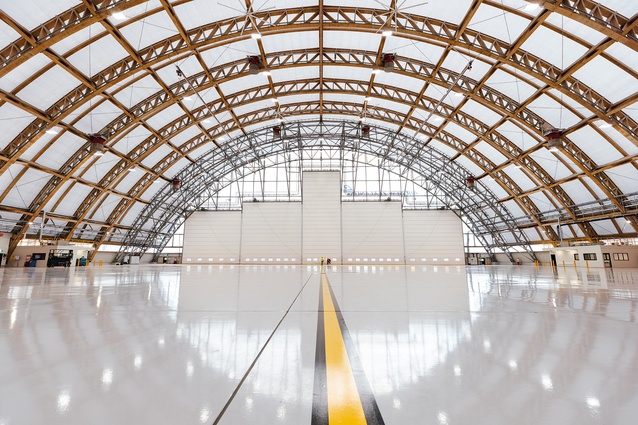
The hangar floor includes 11 large underground pits, which provide a range of services to the engineers when their mechanical lids are opened.
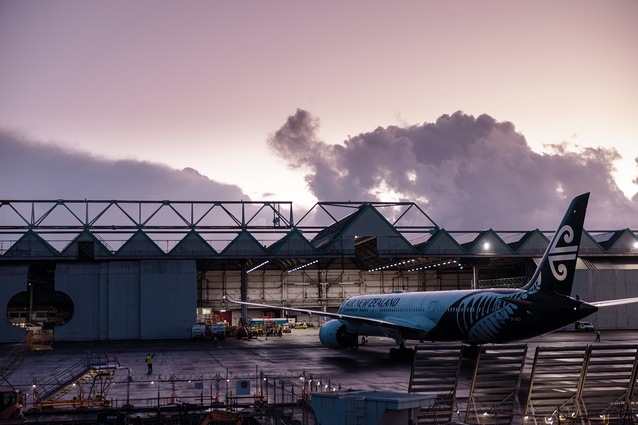
The old Hangar 2 is too small for the latest generation of aircraft.
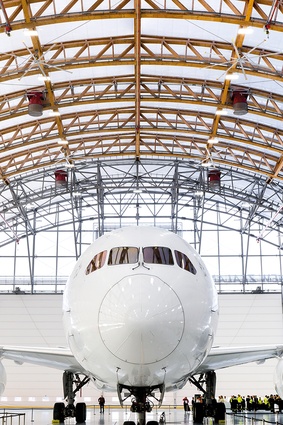
The last three trusses are steel to absorb the extra loads imposed by the system of massive doors.
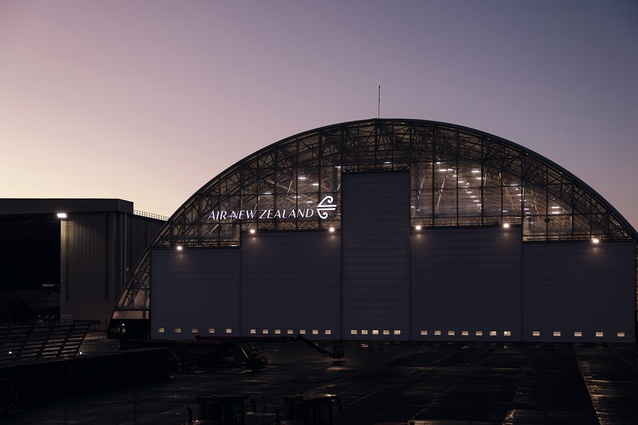
The façade above the doors was made clear to provide workers inside with views out and to allow the interior space to be appreciated from the runway.
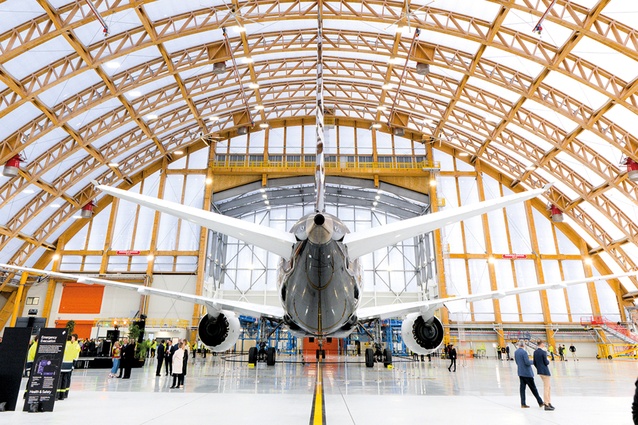
An emergency fire-suppression system hangs from the roof.
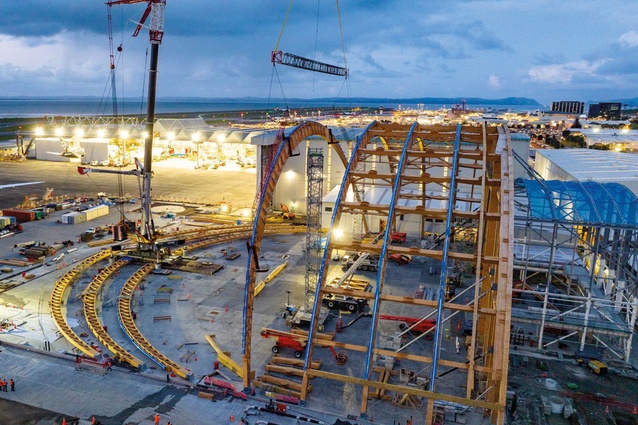
Hinging the vast, 38-tonne trusses to the ground kept them in place during lifting.
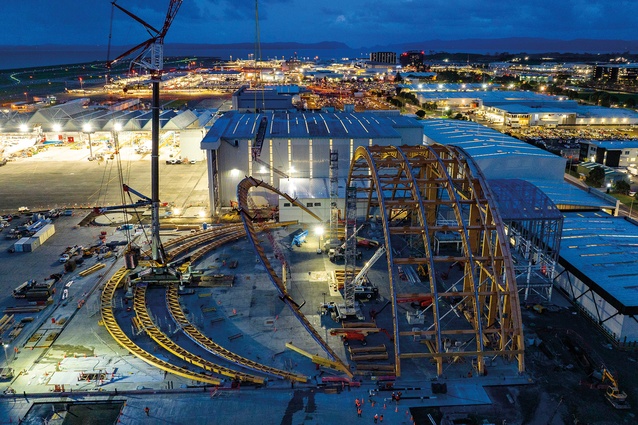
Hinging the vast, 38-tonne trusses to the ground kept them in place during lifting.
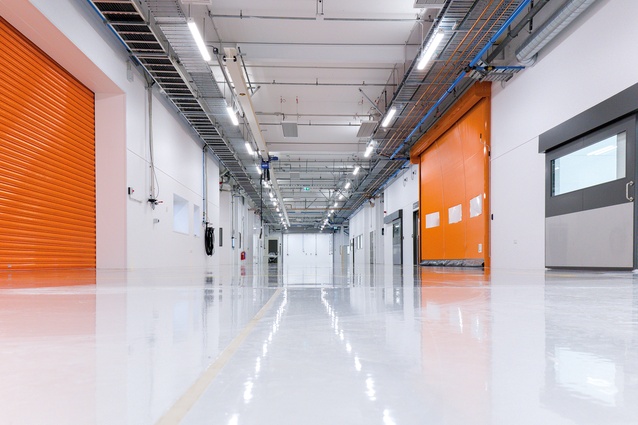
Tool store and workshop areas are shared with Hangar 3 next door.
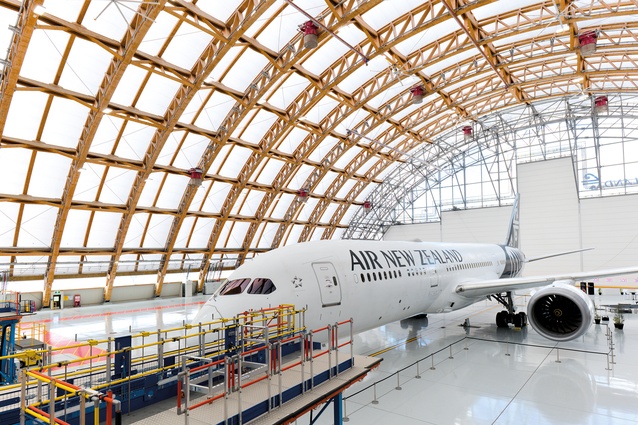
The last three trusses are steel to absorb the extra loads imposed by the system of massive doors.
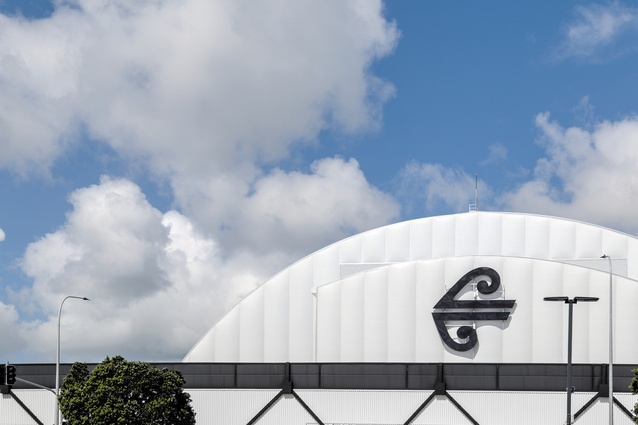
The lightweight ETFE cladding spans further than traditional materials do, allowing the volume of the structure to be reduced.
Andrew Barrie visits the vast, luminous Hangar 4, the centrepiece of Air New Zealand’s maintenance base at Auckland Airport by Studio Pacific Architecture. The building, which achieved Six Green Star certification, is the largest single-span timber hangar in the southern hemisphere.
I was lucky enough to visit Hanger 4 several months ago, thanks to a site visit arranged by the New Zealand Institute of Architects’ head office. They issued an open invitation and, having seen a presentation on its design by Studio Pacific Architecture (SPA) director Evžen Novák, I jumped at the opportunity. By chance, it was arranged that I would give a lift to a postgraduate civil engineering student who was also attending. He was studying the roads and pipes kind of civil engineering, rather than the structural stuff I had assumed would attract an engineer to see the project. So, on the half-hour drive, I quizzed him about why he was attending — he was “just interested” — and how much of the carbon-conscious approach we would see in the architecture of Hangar 4 was present in his branch of civil engineering — “not so much”. The discussion left me pondering over how effective our actions as architects could be when other aspects of the built environment might prove resistant to the kinds of sustainability responses we collectively fret over.
We may spend hours hunched over product declarations and spreadsheets trying, amongst other things, to dial down our use of concrete and steel in favour of climate-friendly mass timber but are we just counting the carbon on the deckchairs of the builtenvironment Titanic?
We now have excellent local exemplars of mass timber buildings of various types. This includes office buildings such as Warren and Mahoney’s new 90 Devonport (2025) in Tauranga, institutional buildings such as Irving Smith Architects and RTA Studio’s Scion Innovation Hub (2020), and educational structures of various sizes, including Tennent Brown Architects’ Ngā Mokopuna (2024) and Cathedral Grammar Junior School (2016) by this writer and Tezuka Architects. We can also look to residential projects, ranging in scale from Mason & Wales’ Student Village (2018) in Dunedin to RTA Studio’s compact new Living House (2025). The car ride out to see Hangar 4 highlighted the question of how we might employ mass timber beyond these building types — in the other kinds of construction which account for so much of the wider built environment: bridges and transport infrastructure, agricultural and industrial buildings, power and data facilities, and so on. There are fairly strict limits to this line of thought; we are unlikely ever to have timber footpaths or motorways or sewer pipes. Likewise, it might be intellectually satisfying to produce structures entirely in timber, but it is likely to be technically difficult and possibly not cost effective. The productive path forward is to use timber for what it’s good at. Warren and Mahoney’s 90 Devonport, for example, combines timber columns, beams and floors with steel bracing. Similarly, plenty of potential remains for mass timber in new applications, even if it is only in particular parts of projects. Opportunism is key.
Hangar 4 is the centrepiece of Air New Zealand’s maintenance base at Auckland Airport. It was required to accommodate simultaneously a large wide-body aircraft of the type used on long-haul international flights, as well as two of the narrow-body planes Kiwis know from hops between our big cities.
SPA’s work at Auckland Airport began with a master-planning project, which led, in turn, to Hangar 4. The practice was behind one of Aotearoa New Zealand’s most ambitious long-span timber structures: the award-winning Aviation Display Hall at the Museum of Transport and Technology in Auckland, completed in 2011. The Hall included several innovations, including huge portal frames of LVL, but is only half the span and only one fifth the area of Hangar 4 — a project of a scale not previously attempted in New Zealand.
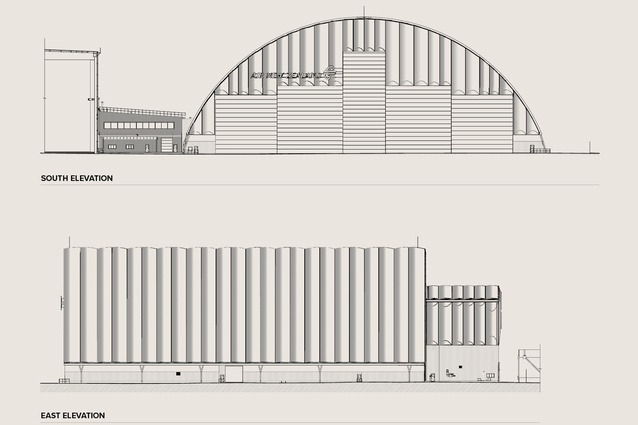
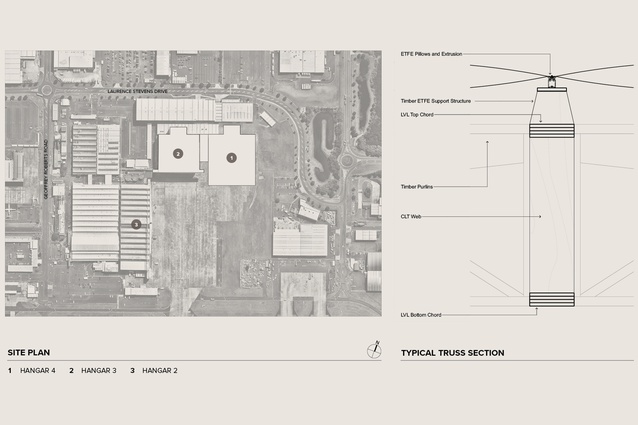
SPA’s design process for the building didn’t assume a mass timber solution but began with a detailed comparison of timber and conventional steel options. Timber won out over steel because of its environmental benefits, light weight, seismic flexibility and resistance to corrosion from salt air — the coastline is just a few hundred metres away. The early involvement of timber suppliers confirmed timber was cost competitive with steel. The resulting design has a clear span 98m wide and 35m high and, at 10,600m2, the hangar is the largest single-span timber hangar in the southern hemisphere – half as big again as Air New Zealand’s largest existing hangar. This vast space connects with another 6000m2 of workshops and engineering spaces: the whole knitting into an existing set of hangars, aprons and airside operations.
The facility is state-of-the-art. There’s an intricate adjustable platform to allow work around visiting aircrafts’ maintenance-intensive nose sections but most of the specialist gear is out of sight. Key items are buried beneath floor level, built into the slab so as not to impede aircraft movement and yet to be efficiently accessed when required via heavyduty trapdoors. Parts and equipment are stored in workshops and tool rooms arranged down one side of the main space. What impresses a visitor is the contrast between the vast scale of the space and the fastidiousness of the processes undertaken within. As with surgical teams, all tools and parts are meticulously counted out and counted back in to the workshops. The stakes, of course, are high — you wouldn’t want to be a technician wondering where a spanner is, only to realise it’s possibly bouncing around the mechanical innards of a plane now cruising at 30,000 feet. The designers targeted an ambitious Six Star Green Star certification. In addition to the project’s carbon sequestration through the use of mass timber, the ETFE façade reduces operational energy use. It admits daylight, lessening the need for artificial lighting, and insulates the building, eliminating the need for active heating. To confirm this, the hangar was thermally modelled to ensure it stayed within the desired temperature band across the year. Active louvres in the façade allow stack and cross-ventilation, and large fans assist with airflow to ensure a comfortable working environment.
But achieving this was not easy. The huge trusses, which combine elements of LVL and CLT, were each factory-assembled in five 25m-long sections in South Auckland and transported to the site. These sections were joined together flat on the ground, fixed to the floor slab at their ends with huge steel hinges, and then rotated up into place by New Zealand’s largest crawler crane. The constrained site and the need to keep construction moving required all sorts of logistical and geometric cleverness. The crane moved across the site 2m above the ground on a temporary platform, allowing the 600mm-thick trusses to be assembled in sequence on the ground behind the crane. As construction progressed, the crane could slowly roll back along the length of the building, its movement impeding neither the ongoing truss assembly below and behind it, nor the finishing work carrying on in front of it. The ETFE pillows, which are corrosion resistant and thermally insulate the space, were then fixed over the structure.
Despite being built from mass timber rather than spidery steelwork, the finished building is incredibly slight. The light filtering through the ETFE pillows, slender trusses and widely spaced purlins give the vast space a luminous, floating quality. At the time of the site visit, the building was still receiving its finishing touches. Key members of the design and construction crew spoke about the project, all with the authoritative but mutually appreciative tone of a team which has collectively pulled off something difficult. The talk was less about the physical structure than about the effort expended on getting those slender elements into place: a years-long process of solving intersecting problems of logistics, sequencing, temporary works and heavy equipment, all complicated by the need to ensure continued operation of the facilities the new building shares with the existing hangar next door. All that effort is invisible now; as is characteristic of well-designed big projects, what remains is a rigorous alignment of architecture and engineering that is experienced in the building through the unusual combination of scale and elegance.
SPA has provided an exemplar of a new building type executed in mass timber. As is often the case with innovation, our mass timber buildings have, thus far, tended to be special things — high-profile buildings with ambitious designers and adventurous clients. Expanding into new territory is likely to remain the domain of designers and clients with the resources and daring to take up opportunities. The challenge for us in the wider profession is to form a cohort of fast followers behind those leading innovation — rationalising and simplifying ideas and systems to enable their use in everyday buildings. In this way, we can all contribute to the necessary and collective endeavour of evolving the way we build.