Designing out waste: Designing out the skip bin
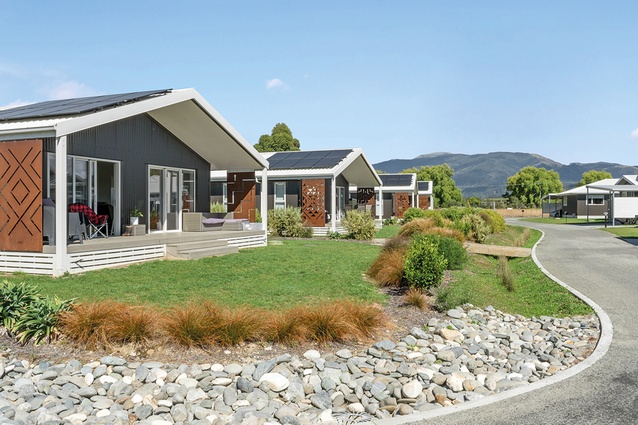
Te Āwhina Marae Papakāinga.
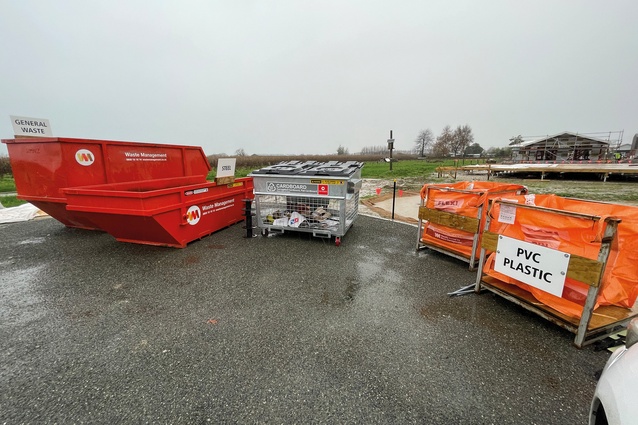
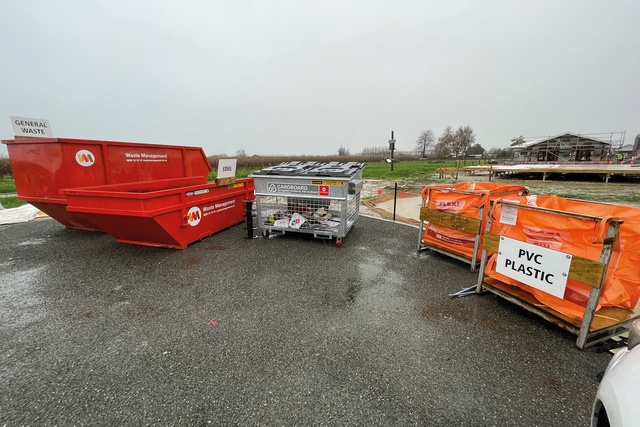
Eight waste-sorting streams were established on site for recycling and waste diversion at Te Āwhina Marae: untreated timber, steel, plasterboard, general waste, mixed recycling, coloured film, cardboard and PVC pipe. This achieved an admirable 48 per cent waste-diversion rate.
In our second sustainability thought piece from Te Kāhui Whaihanga New Zealand Institute of Architects, Rachel MacIntyre looks at why architects are uniquely suited to prevent waste through design.
Walk past any construction site in Aotearoa and you’ll see skips overflowing with offcuts, packaging and perfectly usable materials. The average Kiwi home build generates four tonnes of waste, valued at more than $31,000,1 and construction waste is the largest contributor to landfill.2 We tell ourselves better wastemanagement plans will fix this but we’re treating symptoms while ignoring the underlying issue.
Waste generated on site was designed into the project. And, if waste is created by design, it must be prevented by design.
Architects are uniquely positioned to make that shift, not through better intentions but through better decisions.
Construction waste isn’t primarily a failure of builders or contractors. It’s the outcome of decisions we make in concept design, detailing, procurement strategy and the ways in which we manage uncertainty. Research underpinning the Royal Society of Arts’ Great Recovery project, led by Sophie Thomas, argues that the majority of a product’s environmental impact is locked in at the early design stage. Buildings are no different: decisions made at concept stage shape energy use, material flows and waste for decades.
The prevailing approach among architects treats waste as an operational issue and as something to be sorted once construction begins. This maintains the status quo because it assumes our designs can remain unchanged while responsibility shifts downstream. But the biggest drivers of waste are locked in before earthworks begin: over-specification, non-standard dimensions, details that assume demolition rather than disassembly, over-ordering and misaligned procurement models. Waste is a design outcome.
Where we have the greatest influence
We exert our greatest influence over material efficiency at the stages where waste is least visible. We embed waste into projects through things like excessive allowances and over-ordering, details that cannot be disassembled or designing without reference to standard material modules.
Designing out waste requires putting effort in earlier, when it’s most effective.
Strategies that work
- Implement early planning and collaboration. Engage clients and contractors before designs are locked in. Develop integrated project wastemanagement plans that include the design phase, with clear accountability.
- Leverage technology and data. Building Information Modelling enables material visualisation and waste identification before construction begins. Life Cycle Assessments evaluate environmental impacts when design decisions can still be changed.
- Prioritise material selection matters. Focus on reusable, recycled, low-carbon and bio-based materials. Adopt cradle-to-cradle principles. Make material circularity a project requirement, not an aspiration.
- Retain and refurbish first. Reject the default of demolition. The most sustainable building is often the one already standing.
- Work with standardisation. Working intelligently with standard material sizes and repeatable details eliminates offcuts whilst enabling continuous improvement.
- Embrace offsite manufacturing. Factory-controlled environments dramatically reduce material waste whilst improving quality. This requires early contractor involvement during design development.
- Design for disassembly. Conceive of buildings as assemblies of recoverable parts. Use reversible fixings, layered systems, accessible services and clear documentation of material intent. These moves require no aesthetic sacrifice; they require foresight.
- Understand procurement as a design variable. Traditional models and late contractor involvement incentivise over-ordering. Early engagement and integrated processes consistently produce lower waste because the system allows waste to be designed out.
- Make waste reduction non-negotiable as health and safety are. Appoint onsite Waste Champions. Embed waste reduction in contracts from the start. Include procurement questions in RFPs that reward waste minimisation. Implement frameworks like REBRI (Resource Efficiency in Building and Related Industries) and Homestar. Homestar sets tiered targets for construction-waste diversion from landfill, each earning progressively more points; Homestar v5 also rewards projects that design waste out at the outset, rather than just divert it on site. The focus has shifted from purely measuring diversion rates (percentage kept out of landfill) to measuring waste-generation intensity (kg/m²) alongside waste-elimination strategies.
The business case
Designing out waste delivers rare alignment: less material means lower embodied carbon; less waste means reduced labour, transport and disposal costs; and greater certainty means fewer delays and claims.
Te Āwhina Marae Papakāinga3 in Motueka demonstrates this in practice. On their first largescale waste-reduction attempt, Scott Construction and Waka Group Architecture achieved a 48 per cent land-fill diversion rate across 20 new homes, delivering a minimum of 13 per cent cost saving4 on waste disposal. Strategic design decisions drove these results: screw piles instead of traditional foundations and wool insulation replacing fibreglass. These choices cut waste, accelerated build times and reduced costs. Targeted education shifted the team’s mind-set around waste minimisation and efficiency. The project proved that commitment and proper preparation deliver measurable outcomes from the outset.
Four questions

To date, waste reduction has focused on efficiency rather than on changing the underlying patterns of building more, bigger and with ever-greater resource demands. What if every design project began with four questions:
1. How much new virgin material do we really need to use?
2. How much existing material can we redeploy?
3. How will what we build today become tomorrow’s material bank?
4. What would change if we measured waste generation (kg/m²) instead of only diversion rates (%)?
These questions require a shift from a ‘waste management’ to a ‘resource strategy’ mind-set. Materials become assets. Systems are designed for disassembly. Extraction occurs only when essential. Data collection becomes integral to practice. Waste elimination is designed in from the start. Demolition is reframed as planned material harvest.
The skip bin isn’t an inevitability. It’s a consequence. And, like most consequences in the built environment, it can be redesigned.
References
1. Accelerating industry action on waste management, BRANZ.
2. Construction and demolition waste is currently responsible for 50 per cent of waste to landfill. New-Zealand-Construction-and-Demolition-Waste-Baseline-and-Tracking-Methodology-Report.pdf
3. Te Āwhina Marae Papakāinga – Waka Group Architecture.
4. The 13 per cent figure has not been independently verified — a reality that reflects the genuine challenges small practices and construction companies face with data collection and verification on small projects. This is an area the entire industry struggles with, yet the results still provide valuable insights into what coordinated waste-reduction efforts can achieve.