Darklight: The Edge of Light
A Descent into Colour was held 2–5 September 2025 Okahu, Tāmaki Makaurau. Karl Poland takes its (colour) temperature.
Stumbling in with dreams of an evening at laser tag: dimly-lit rooms, smoke machines, tracer beams and googly-eyed things — while these, for the most part, didn’t go astray, Darklight’s second hurrah, instead, rumbled Ōkahu Bay with hues of a minimalist’s ‘light touch’. Riding the success of Darklight: A Descent into Colour, Angus Muir and Dan Move returned with a new sensory experience on Auckland’s waterfront.
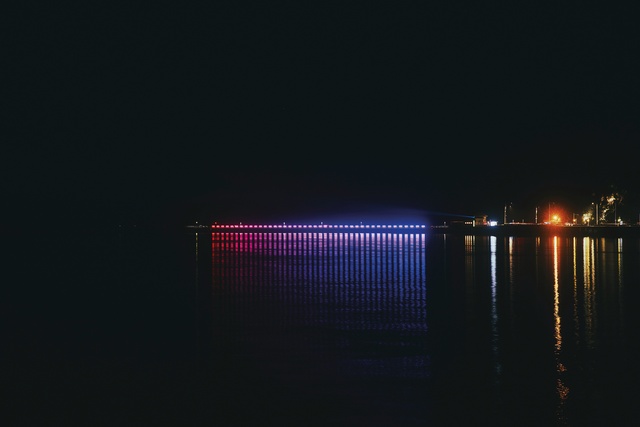
The Edge of Light electrified the colonial cornerstone of Tāmaki Drive and reimagined it as a lighthouse, drawing in an eclectic dinghy (LEDs fastened to the hull, I hope) of artists: Angus Muir, Matt Liggins, Catherine Ellis, Simon Holden, Peter Hobbs, Luke Foley-Martin and Sarah Jayne Kavali.
Beyond the bouncer, shrouded in haze from beneath the door, was a feeling that can only be described as undeniably “deer in the headlights”. PXLD, Ellis and Hobbs’ pleasurable assault on the eyes and ears, Horizon, set the tone. Staccato-ing glitches of rectilinear lights and sonics manipulated from electromagnetic recordings around the bay were sure to have fractured fissures at the venue’s foundations. Meanwhile, in the next echo chamber, Ellis and Hobbs reverberated a synthesis of music and light from a reflective oval pool; Cymatic Etherium felt like elaborate proof of making contact with higher life forms. An ancient alien script of goth-like hieroglyphs, produced by refractions, appeared to etch into the drywall, eat through to the next, and speak through Hobbs’ synthesisers.
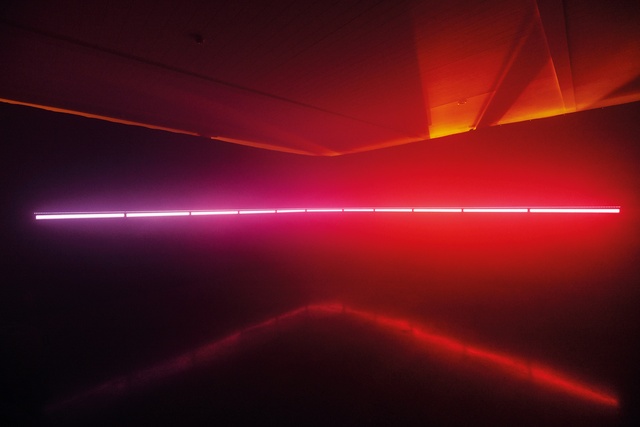
Cocktail in hand, PXLD’s Signal, a monolith straight from Stanley Kubrick’s 2001: A Space Odyssey, turned horizontal, rotated perpetually and hummed hypnotically with a built-in heartbeat. For a fleeting moment, I sympathised with its meaningless reality — does it have a soul? Sometimes disgruntled, blaring at full-bore; other times, happily cycling through its whirring existence. Maybe it was the espresso martinis talking, but somehow you felt badly for the bugger forced to centrifuge at our whim. Next door, the sun — let’s say Kubrick’s — was housed in a Minesweeper-like 39x39 square grid, spec’d with supersized stage light proportions. Sunrise(t) gave Olafur Eliasson a run for his money. By distilling our planet’s kiss good morning(night) into an intentionally compressive format, MAD Studios laid bare its beauty, even at its most lo-fi resolution. The contrast offered by hi-fi momentous audio by Arli Liberman made staring down the barrel of a sun just that bit more face-melting.
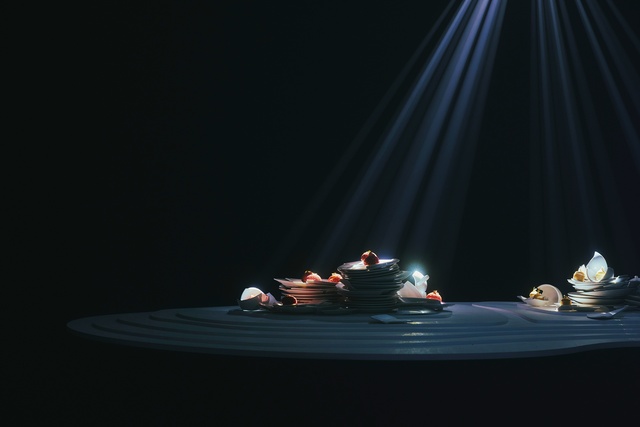
Stranded on a projection-mapped island sat a stack of sinking plates: not tectonic plates but broken plates. Whether or not Kavali and Creature Post’s performative Porcelain explicitly commented on coastal inundation or food insecurity, it was hard to ignore these facts when, beneath the floorboards, the Waitematā’s coastline shifts. The urban littoral became literal when, with some hesitation, we plundered its last resources of delicate canapés. Ooh, you know what, I think I’ll try the choux (pronounced “shoo”)1. Though audience participation climaxed in Flux, a vat of real-time, motion-tracking molten muddled by you and me playing both spectator and spectated. Trace Element and Holden’s seductive honey-pot surveillance system was offset by the silliness of swimming through a sea of precious minerals (especially post-pillaging an isle).
Off to the side, eight not-so-still lifes — still lights? — rewarded a closer inspection. Orbit projected vignettes capturing microscopic-like light surface-scattering, an abstract artefact. Under extreme sensitivity, Foley-Martin used light as both protagonist and paintbrush. Outside, the angle brush came out when digitally spliced waterfalls were cut into the porthole façade. Were we sinking or just staying afloat? The levee broke. Darklight’s edge conditions (low-tide/high-tide, visible/vanishing, liquidity/stillness) burst clear.
Waltzing out to The Edge, choreographed light and the unpredictable harbour danced to muffled syncopations from within the artists’ ‘lighthouse’. Punters pondered whether or not the wharf’s array of zip-tied tube lights should remain permanent. I would argue against this notion. Not just for the poor fish – but because Darklight’s strength lies in its temporality. I’m not talking zip-ties, but rather, transforming spaces through ephemeral encounters of shared spirit proves potent as a form of spatial activation on the periphery of traditional practice. Buoying between installation, graphic, interactive art and boutique hospitality — Darklight’s interdisciplinarity is like some sort of nomadic techy carny that obviously performs best with the lights off. Setting up shop in unexpected shadows, finding spaces to gleam, before moving onto the next, is an advantageous way of telling stories of light — something that’s hard to hold down.
References
1 A raspberry cream French pastry, with a raspberry crunch and finished with a flicker of gold leaf. NF. VEGETARIAN.