NZTA’s tunnel vision risks another harbour crossing failure
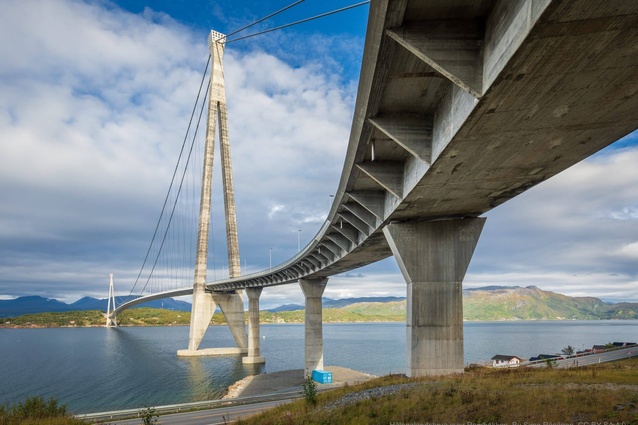
The Hålogaland bridge in Norway spans 1,500m across the Romsdalsfjord. Completed in 2018, it is a prestressed concrete suspension bridge that cost NOK 3.5 billion (NZD $611 million) and took five years to build. The Hålogaland bridge has walking and cycling lanes and was built by a Chinese construction company.
Garth Falconer of Reset demands the NZTA offer the public light and transparency before the end of their tunnel plans.
Reset was pleased to receive a response from NZ Transport Agency Waka Kotahi (NZTA) to the article published by ArchitectureNow.co.nz about its internationally award-winning Waitematā Harbour Crossings proposal.
(Editor’s note: You can read NZTA’s note at the end of our previous article on Reset’s harbour crossing design)

It’s the first time we’ve heard back from the government-owned entity regarding our numerous second Auckland bridge concept articles published over the last five years, all aimed at drawing attention to the agency’s baffling lack of alternative options and closed-door processes.
But we need more than just a response to editorial from NZTA. Greater transparency, and the involvement of independent experts is vital. Getting the second Auckland harbour crossing right is in everyone’s best interests, and we’re running out of time.
We’re not alone; Barney Irvine, Executive Director of the Northern Infrastructure Forum called out the NZTA, asking them to ‘break the cycle of planning failure’ in his recent NZ Herald article.
The Northern Infrastructure Forum is a policy and advocacy organisation made up of infrastructure planning and decision-making leaders to help raise the standard of new built projects across the Upper North Island.
Let’s hope this marks the beginning of a more considered process as NZTA moves towards announcing the Government’s preferred approach for the additional Waitematā crossing in the coming months.
But NZTA state in their response to us that ‘the only two options being considered are located to the east of the existing Auckland Harbour Bridge.’ Disappointingly, after all this time, and with all the money they’ve spent, they’re already heading in the wrong direction.
A new bridge against the existing iconic bridge will not fly with the public, and a tunnel is simply unaffordable.
Costly and Mishandled Initiatives
There have already been at least four additional Auckland harbour crossing projects announced by NZTA on behalf of governments of the time, and all of these ideas have been shelved. This work has come at considerable cost to the taxpayer.
The overall project spend since 1996 has not been disclosed, though it is public knowledge that the Northern Pathway, an NZTA initiative, cost $63 million and was withdrawn mere weeks after its 2021 announcement. With the latest study budgeted from 2023 at $60 million, that’s a current spend rate of over $1 million per month. The actual scope of work remains unclear, especially considering previous efforts. If earlier work was insufficient, it raises questions about oversight and transparency, as little to nothing has been shared with the public.
It may come as a surprise to some that in December 2023, the Government advised that ‘Waitematā Harbour Connections should not proceed with the light rail or walking and cycling components of the project.’
With increasing calls for people-powered transport links, this is unacceptable. We need to be decreasing traffic congestion and increasing access.
New Zealand taxpayers do not want to keep paying out for poorly conceived plans, or proposals that do not eventuate.
Absence of Peer Review
The lack of input from independent experts into this, the biggest infrastructure project New Zealand has ever seen, is cause for real concern.
Throughout the project’s history, NZTA has been resistant to criticism and alternative proposals. Since 2008, the agency has heavily favoured a tunnel, and only recently, in 2024, has had to entertain a bridge option when the incoming Minister of Transport instructed it to do so.
Independent peer review is a hallmark of best practice on large projects, offering impartial assessments that help prevent costly mistakes and ensure robust design.
For a project of this magnitude, an independent expert peer review panel would typically be established, as is standard for all major Auckland waterfront developments and those conducted by the Auckland Council Urban Design Panel.
Greater Auckland’s Connor Sharp agrees and says in a recent piece: “…We’re stuck constantly pouring our money towards experts who beaver away in secret on projects deemed politically sensitive, only revealing their near-complete shovel-ready designs at the very last minute, to public dismay. Luckily there’s a promising way forward. An independent commission that researches and ranks all large-scale, long-term projects — with the results then presented to a citizen’s assembly for consideration… It would also refocus the experts — and our precious public investment — on maintaining transparency, clarifying what’s at stake, and regaining trust.”
We ask that NZTA engages an independent peer review panel without delay.
Lack of Public Engagement
NZTA has been tasked by central government to manage the process, yet public involvement has been minimal.
Auckland’s Mayor Wayne Brown has voiced concerns about being excluded from key discussions as the NZTA’s experts continue to develop and assess options behind closed doors.
The NZTA’s ‘have your say’ campaign in 2023 was low-profile, open to the public for only six weeks and provided a hugely inflated figure for the cost of the bridge option. Somewhat coincidently it equaled the cost of a tunnel. International and national precedents firmly indicate that constructing a bridge is about a tenth of the cost of a tunnel and less prone to cost blowouts.
Labour Party leader Chris Hipkins quoted the ‘have your say’ survey in his recent State of the Nation speech during question time saying a second harbour crossing is estimated to cost $20b.
Evidently, by accepting this unacceptably inflated cost, the current Coalition Government and the opposition parties have been seriously misinformed. They urgently need to listen to qualified experts from outside a crown-owned entity.
This lack of transparency has done nothing to build public trust, confidence and buy-in.
Delays and Risks
The process for the second Waitematā Crossing began in 1996 and has continued with a series of shelved projects for 30 years.
As Irvine says ‘over this time, the condition of the existing bridge continues to deteriorate (alongside ongoing maintenance and upgrades, further restrictions on trucks could be needed within 15 years) and construction costs in general continue to march upwards.’
The urgency for a second harbour crossing is clear. As a consequence, the range of options available — based on what we can afford, what can be constructed, and the structural integrity of the existing bridge — gets narrower and narrower.
The priority, above all else, is to increase the resilience of Auckland’s current harbour bridge.
The upcoming announcement must break the cycle of poor decision-making and its corresponding delays.
Call for Accountability
The Government is already warming the public up to a toll — currently suggested at $9 each way, and this being for the current bridge, before work has even begun on a second crossing.
It’s not too late to demand accountability through an independent review of the process.
With mounting consultant expenses, and 30 years of go-nowhere studies stockpiling, rigorous external evaluation is essential to safeguard public interest and ensure that the project speedily delivers genuine value for New Zealanders, including provision for walking and cycling, dedicated public transport lanes and elegantly fits within our world-class harbour.
NZTA personnel need to do more than just respond to commentary; they need to listen. Their ‘trust us, wait and see’ approach is not good enough.
Garth Falconer 26/2/2026
Garth Falconer, one of New Zealand’s foremost urban designers, is a director at Reset and author of Living in Paradox; a history of urban design across kainga, towns and cities in New Zealand (2015) and Harry Turbott: New Zealand’s first landscape architect (2020). He was the former design lead of the SkyPath project.