After the rain: Preserving timber
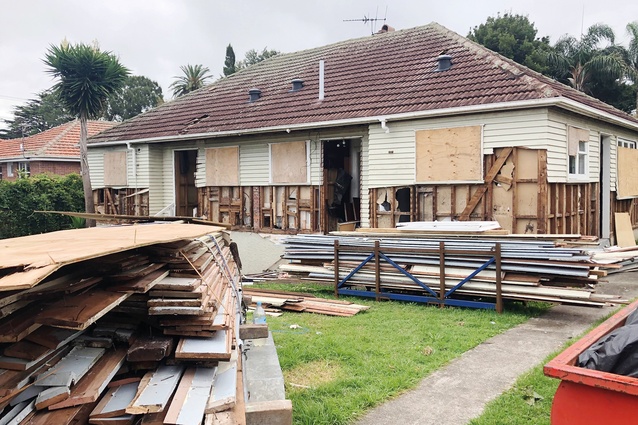
Careful work by hand maximises timber yields.
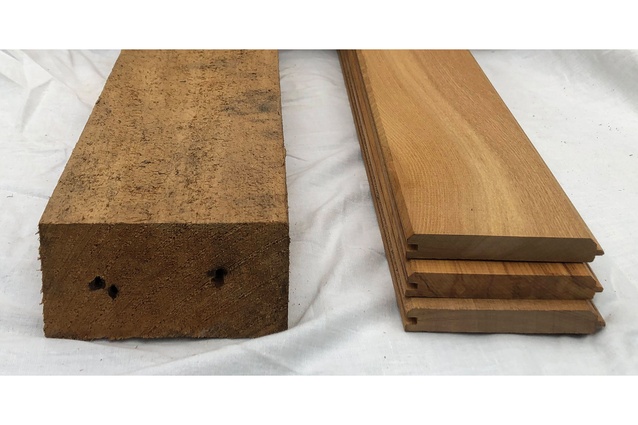
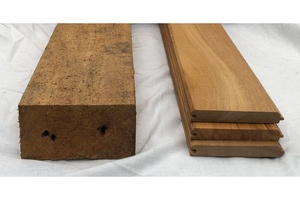
Recovered rimu wall is converted into tongue-and-groove flooring.
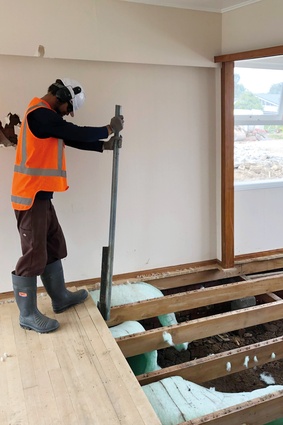
Deconstruction teams have developed techniques for efficient recovery.
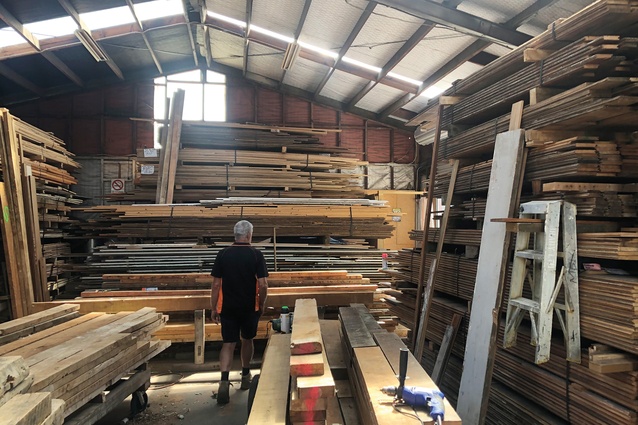
Yields from individual buildings can be small but recyclers can accumulate useful quantities of material.
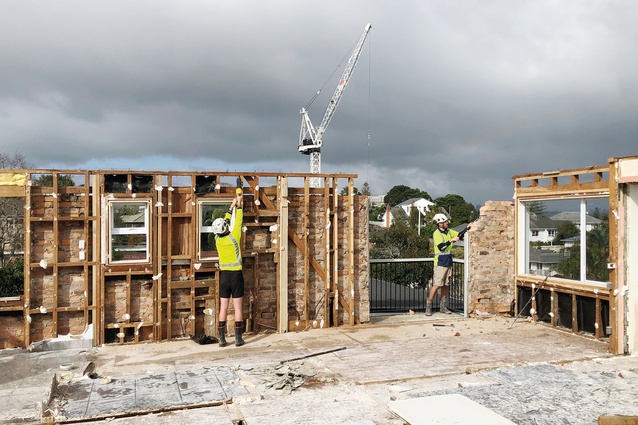
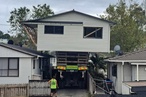
A building in the process of being deconstructed.
In the third of a six-part series, Andrew Barrie examines the recovery and re-use of native timber and its implications for our wider circular economy.
Like most of the population, architects have an understanding of the circular economy that likely relies on their most frequent engagement with it: their home recycling bin. We diligently deposit our boxes, bottles and cans in the expectation that they go off to be duly sorted, processed and, somehow, returned to the flow of materials — paper, metal, glass and plastic — that generate our world. Of course, recent changes to our recycling system made it clear that many things were not in fact being recycled; a previously veiled lack of capability in local systems meant that it is more honest and efficient for a range of potentially recoverable materials to be sent straight to landfill.
It is a bit the same way with construction materials. As noted in previous articles in this series, there are well-established pathways for recycling concrete, steel and glass. The pathways are much less developed for timber. Most of our recovered timber is plantation-grown pine but, by the time it re-emerges onto the market, the cost savings of recycled over virgin material don’t, in themselves, warrant the extra effort and risks. Further, timber’s strength profile changes over time. It tends to become more brittle and porous, particularly when exposed to the elements. Dr Gary Raftery at the University of Auckland is researching the durability of mass timber when exposed to the weather, and is developing the science by which such non-virgin timber might be able to be reused or repurposed. Until this is achieved, warrantee and certification issues make it tricky for recovered timber to return to structural use. Some goes to Community Recycling Centres (CRCs) — the consumer face of the circular economy — for DIY use, or is shipped to Pacific Island communities. Beyond that, most of what is not chipped and burned for energy goes to landfill.
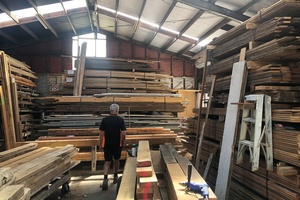
At present, the timbers most likely to be saved are native species. Even then, a key frustration for Claude Dewerse and Mike LeRoy-Dyson in their project to help relocate or deconstruct 1200 flood-compromised Auckland houses is the lack of respect given to these materials: “native timber is a non-renewable resource.” They point out that most of our useful native species are slow growing, effectively eliminating the possibility of plantations ever providing the material. Aside from a trickle of swamp kauri, river-recovered wood (logs felled but sunk in rivers and lakes en route to milling) and occasional tiny harvests from private land, we’re unlikely, ever, to have reliable new supplies of native species such as kauri, rimu, mataī or tawa. So, how do we not only preserve these precious materials but upcycle them? Can we bring timbers hidden in walls and under floors at a time when they were ubiquitous out into spaces where they can be shown off?
There are two key issues: the first involves the economics and logistics of recovering the material; the second relates to developing applications and end uses.
The deconstruction of large old structures – warehouses, institution facilities, infrastructure — can yield significant volumes of native timbers but the most accessible source of the material is old bungalows and villas. However, the popular appeal and relocate-ability of these houses means they are only rarely dismantled; work on these houses is more likely to require supplies of native timbers than to provide them. However, rimu was used as rough-sawn framing timber from the 1940s to as late as the early 1980s. Auckland deconstruction company Levela Deconstruction, for example, has developed techniques to extract this rimu framing timber, clean it up and process it into tongue-and-groove flooring. A team at the University of Auckland led by Prof. Paola Boarin and Dr Alessandro Premier is collaborating with Dewerse and LeRoy- Dyson to develop a ‘scan to BIM’ process that will efficiently provide accurate assessments of the volume of timber in an old house.
Only the bigger deconstruction firms have regular access to the large volumes that allow architects to specify timbers readily but commercial realities result in fairly high prices. The CRCs are likely to be much more cost competitive but tend to receive relatively small volumes. That said, some CRCs are keen to act as agents and, given some lead time, will accumulate or locate material to fill larger orders. Dewerse and LeRoy-Dyson acknowledge the chicken-or-egg nature of the present situation: recyclers won’t go the extra mile to extract material they are not sure they can sell; architects are reluctant to specify materials for which supply or quality is uncertain. However, Dewerse and LeRoy-Dyson encourage architects keen to support the circular economy to put some energy into developing relationships that will allow them to source what they need when they need it: “Like anything, you do it a few times, you make the contacts, you find the people.”
As is the case with many new developments in design, the use of recycled materials may change the order in which architects tackle their tasks; it may require sourcing to be confirmed earlier in the project, creating contractual complexities and logistical problems such as the need for storage. These issues might even become routine, such as when projects require re-insertion of material recovered from their given site into new construction.
These logistical complexities of circularity are matched by the design challenges of dealing with it aesthetically. One path forward in our part of the world may be the rising expectation, with its roots in te ao Māori, that buildings tell stories about the places where they stand. Thus far, narratives have largely been expressed artistically — decorative imagery or the metaphorical use of building form — but there is also likely room for stories to be told through physical materials themselves. There have been high-profile local examples. When John Scott’s Āniwaniwa Visitor Centre at Waikaremoana was controversially demolished, its linings were harvested, stored and reused in Tennent Brown Architects’ celebrated Te Wharehou o Waikaremoana (2016) that replaced it. Mike Davis’ award-winning Venice Benches (2020), part of an exhibit about Aotearoa New Zealand’s culture of building in timber, employed dumpster-bound weatherboards from a fire-damaged state house.
Another path for architects might be to set aside the large, smooth surfaces so beloved of modernism. In heritage refurbishments, architects have become comfortable with stripping back surfaces and leaving the blemishes of history exposed. Could this tolerance be extended to non-original material? We might develop an aesthetic of patches, of small things combined. Again, we have exemplars. Alvar Aalto’s Muuratsalo Experimental House (1954), built for his own use as a summer atelier, is characterised by a façade of patches of various kinds of brickwork, intended as samples for reference during his design work. More recently, Hiroshi Nakamura’s Kamikatsu Zero Waste Center (2020) was constructed in large part by patching together elements harvested from unused buildings in the slowly depopulating rural Japanese village where it was built.
The rise of building rating systems such as Greenstar and the Living Building Challenge, as well as carbon accounting, will incentivise the wider use of recycled materials. But Dewerse and LeRoy-Dyson argue that it will still be incumbent on architects to “sell the story”. Looking back to our home recycling bins, what will eventually allow us to deal properly with currently un-recyclable materials is the advent of local capacity to process them. At that moment, what is now reluctant rubbish will become a resource. Likewise with native timbers. For this to occur, though, architects must play a key role in developing the pathways along which the material can flow back into our designs.
Architecture NZ and ArchitectureNow will report further on Dewerse and LeRoy-Dyson’s project in upcoming issues, hoping to share the lessons architects might learn.
Read previous articles in the series here.